
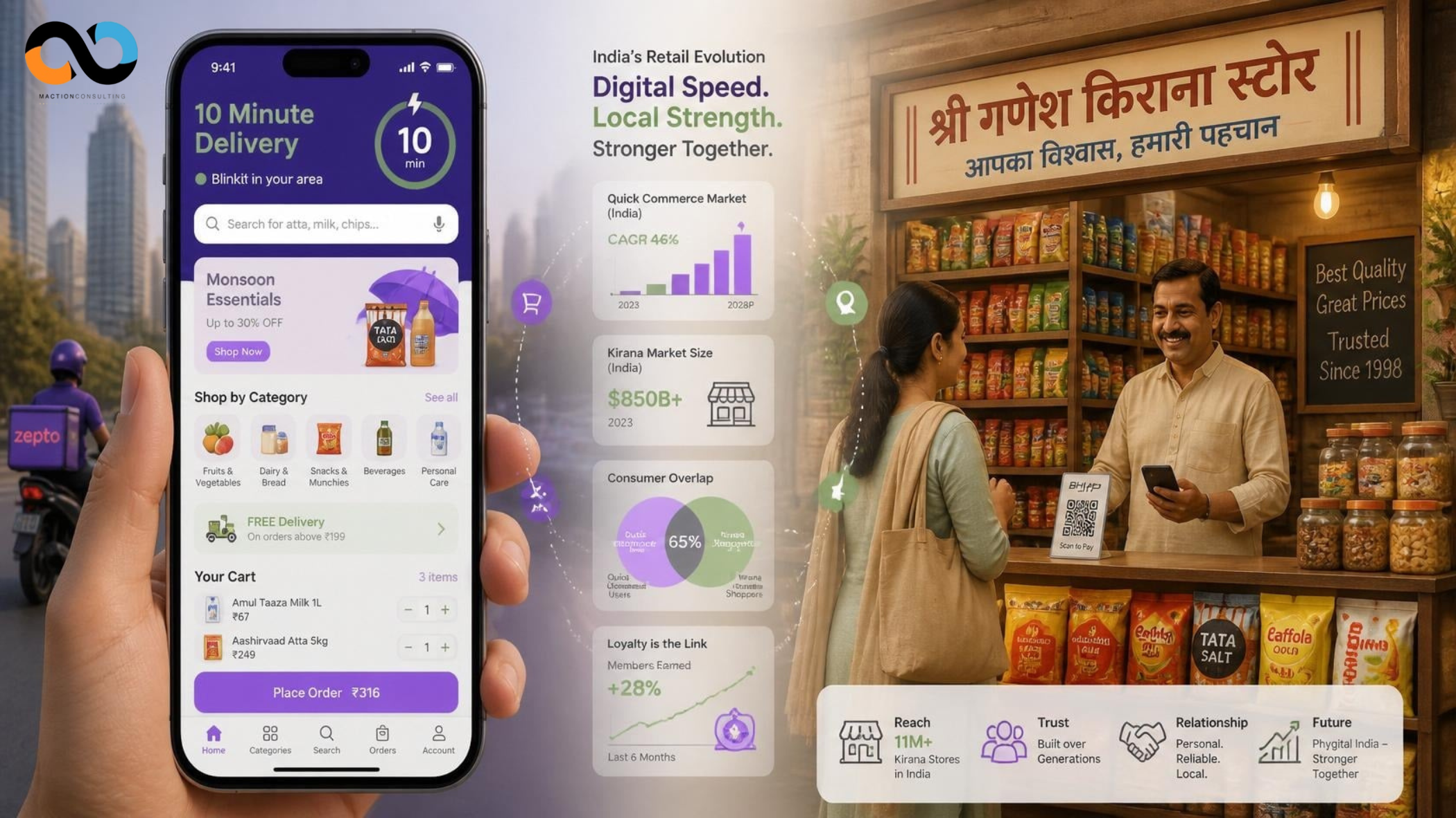

Quick commerce vs traditional retail — it’s the debate reshaping India’s FMCG and brand strategy conversations in 2026. Ask most people in urban India whether the neighbourhood kirana store still has a future, and the instinctive answer is no. Ten-minute delivery apps have become the default for anything from milk to medicine, dark stores are multiplying across metros, and the kirana owner who once called customers by name is increasingly competing with an algorithm. Yet the data tells a more complicated story — and for brands trying to figure out where to invest, that complication is exactly where the opportunity lies.
The Kirana Isn’t Dying — It’s Being Misread
India’s quick commerce sector has scaled at a pace few retail formats ever have, growing from a niche experiment in 2022 to a market worth several billion dollars within three years, with projections pushing it toward the $10 billion range by the end of the decade. Blinkit alone now commands roughly half of that market, with Swiggy Instamart and Zepto splitting most of the rest.
But market-share headlines about quick commerce obscure a more important number: traditional kirana stores still account for the overwhelming majority of India’s grocery spend, by some industry estimates north of 90%. India’s grocery economy isn’t a single battlefield with one winner — it behaves more like three separate markets moving at three different speeds: affluent metro households defecting to apps, a large hybrid segment splitting loyalty between hypermarkets and kiranas depending on the mission, and a much larger mass-market base for whom the neighbourhood store remains the default, not a fallback.
Loyalty Is Being Redefined, Not Erased
The more interesting shift isn’t who’s winning — it’s what “loyalty” now means. Industry survey data from Grant Thornton Bharat, covering more than 1,600 consumers and over 1,000 kirana retailers, found that a strong majority of quick commerce users say they’d keep using these platforms even if discounts disappeared entirely. That’s a meaningful signal: the early quick commerce era ran on aggressive discounting to build habit, but the habit has now outlasted the discount. What’s keeping users loyal today is convenience and certainty of speed, not price.
That distinction matters enormously for research design. A brand tracking “loyalty” through price sensitivity alone is measuring the wrong thing in 2026. The more useful questions are about switching triggers, tolerance for stockouts, trust in delivery windows, and how quickly convenience-driven habits harden into something closer to compulsion — the kind of research that requires structured consumer tracking, not just transaction data pulled from a platform dashboard.
Deciding which approach fits your brief is itself a strategic question — understanding the difference between qualitative vs quantitative research is a useful starting point.
The Real Casualty Is the Middle, Not the Extremes
If there’s a segment genuinely losing ground, it isn’t the kirana — it’s the modern-trade supermarket sitting awkwardly in between. Supermarkets are neither cheap enough to compete with kiranas on small, frequent purchases, nor fast enough to compete with quick commerce on convenience. Quick commerce has been most effective at absorbing “planned” grocery trips that used to go to supermarkets and hypermarkets, particularly among affluent households that already preferred organised, digital-first shopping — not at replacing the kirana’s role in daily, small-basket purchases.
This is a pattern researchers see repeatedly in Indian retail: disruption rarely eliminates the format closest to the consumer’s daily habits. It squeezes the format that was already a compromise.
Where the Two Are Starting to Merge
The sharpest opportunity for both brands and platforms isn’t in the kirana-versus-app framing at all — it’s in the growing overlap between them. A meaningful share of kirana retailers have expressed openness to partnering with quick commerce platforms rather than competing against them, and government-backed initiatives like ONDC are actively working to plug small retailers into digital commerce infrastructure rather than displacing them. UPI adoption is now near-universal even among small stores, which means the “unorganised” retail sector is digitising its back end even where the front-of-store experience hasn’t changed.
For brands, this means the binary question — “should we prioritise quick commerce or general trade?” — is increasingly the wrong question. The better one is how a single consumer moves between both within the same week, and what triggers that switch.
What This Means for Brands Planning 2026–27 Strategy
- Basket-mission mapping matters more than channel share. The same household may use quick commerce for top-ups and a kirana or hypermarket for the monthly stock-up. Understanding which SKUs and pack sizes belong to which mission is now a research question — similar to the way consumer product testing validates which formats resonate before full distribution commitment.”
- Retention research needs to move past discount-sensitivity metrics. With loyalty increasingly convenience-driven rather than price-driven, tracking studies should probe trust, delivery reliability, and stockout tolerance as leading indicators of churn.
- Tier II and III expansion will test different loyalty dynamics. Much of quick commerce’s next growth phase is expected to come from smaller cities, where kirana relationships run deeper and price sensitivity is typically higher — assumptions built on metro behaviour won’t transfer cleanly.
- Kirana partnership models are an underexplored channel strategy, particularly for brands that have historically distributed only through general trade or only through e-commerce.
Frequently Asked Questions
Q: Is quick commerce replacing kirana stores in India?
Not replacing — disrupting a different segment. Kirana stores still account for over 90% of India’s grocery spend. Quick commerce has largely absorbed planned grocery trips from supermarkets and hypermarkets among affluent metro households, not the daily small-basket purchases that kiranas serve.
Q: Why are consumers loyal to quick commerce platforms even without discounts?
Research shows the habit has outlasted the discount. Quick commerce users in 2026 are loyal primarily to convenience and delivery certainty — not price. This represents a meaningful shift from the early adoption phase when aggressive discounting drove growth.
Q: How should FMCG brands think about quick commerce vs general trade strategy?
The binary choice is increasingly outdated. The better research question is how a single consumer moves between both channels within the same week, and which SKUs and basket missions belong to each. Channel strategy built on this understanding outperforms assumptions based on aggregate market share data.
Q: What research should brands commission to understand retail loyalty in India?
Structured consumer tracking studies that go beyond price sensitivity — probing switching triggers, stockout tolerance, delivery trust, and convenience-driven habit formation. Transaction data from platforms captures what consumers bought, not why they chose that channel.
Getting the Read Right
The quick commerce versus kirana narrative makes for a good headline, but most brand decisions being made on it right now rest on assumptions rather than category-specific data. Understanding how your specific consumer base is actually splitting loyalty between channels — and why — is the difference between chasing a trend and building a strategy around it.
If you’re planning channel or retention consumer research for the year ahead, Maction Consulting can help you design a study that captures how your category’s consumers are really behaving, not just how the industry narrative says they should be. Talk to our research team to get started.
If you’re evaluating research partners for this kind of work, our guide on how to choose a market research company in India covers what to look for.



На данном веб-сайте есть шанс отыскать полезную информацию.
https://kart1na.ru/entry/353-tayna-ischeznoveniya-83-letnego-pensionera-v-sverdlovskoy-oblasti/
На этом сайте вы сможете отыскать нужную информацию.
https://wolgograd.ru/column/2958-kak-material-verkha-krossovok-vliyaet-na-komfort-i-dolgovechnost/