
Qualitative vs quantitative research — it’s one of the most common questions clients ask at the start of a research brief, and the honest answer is that it depends on your business question, your stage in the product or campaign lifecycle, and what you already know about your audience.
In India’s highly diverse market — where consumer behaviour varies sharply by geography, language, income segment, and category maturity — choosing the right methodology is especially consequential.
This article explains the core differences between the two approaches, when each is most appropriate, and how combining them often produces the most actionable insights.
What Is Qualitative Research?
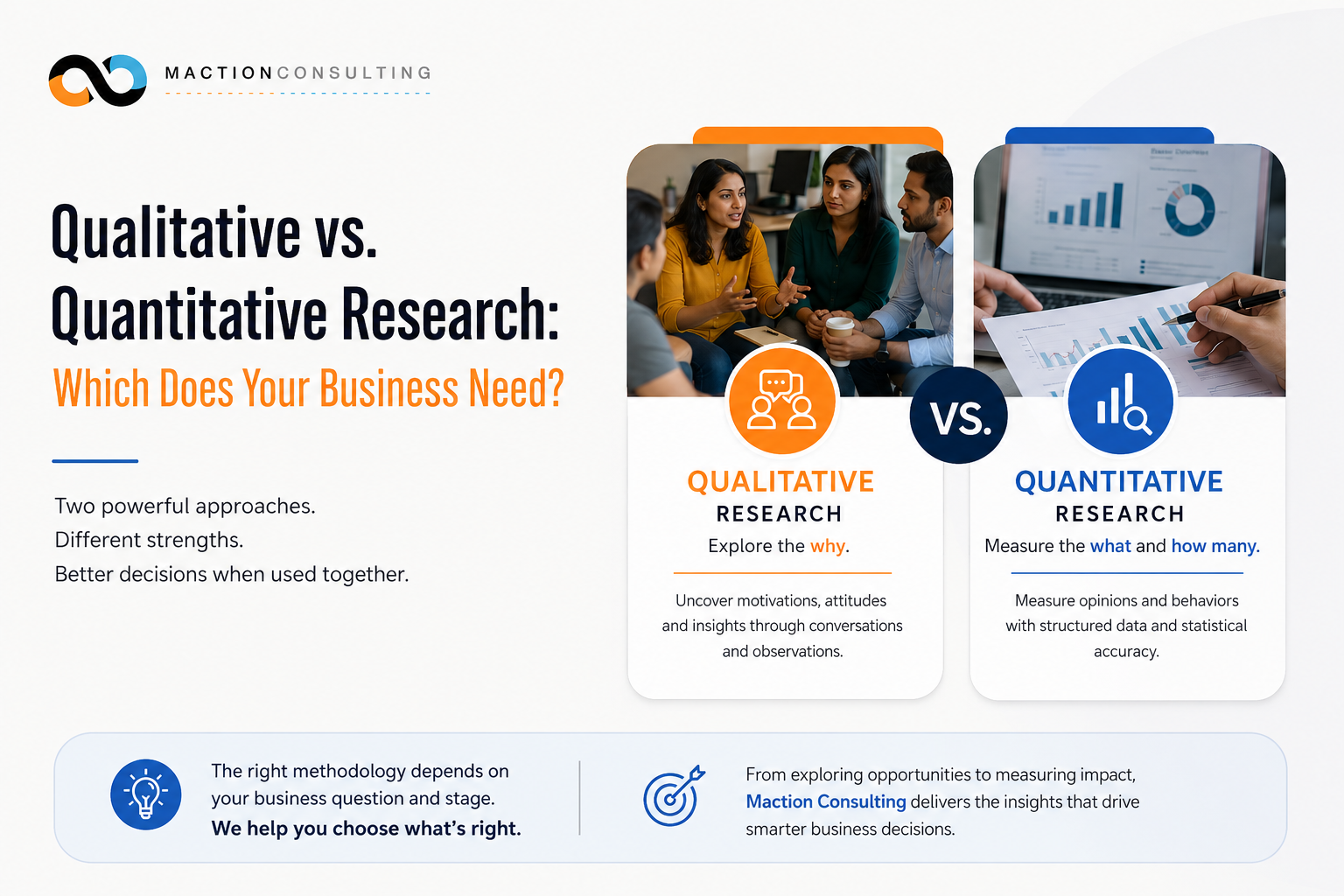
Qualitative research is designed to explore. It focuses on understanding the why behind consumer behaviour — motivations, attitudes, perceptions, and emotional drivers — rather than measuring how many people think or behave a certain way.
Common qualitative methods include:
- In-depth interviews (IDIs): one-on-one conversations that probe individual experiences and decision-making processes
- Focus group discussions (FGDs): moderated group conversations that reveal shared norms, disagreements, and emerging themes
- Ethnographic research: observational fieldwork in consumers’ homes or purchase environments
- Online communities: extended digital forums where participants respond to tasks and prompts over days or weeks
Qualitative research is typically small in sample size — often 10 to 40 participants — but rich in depth. It is not statistically representative, which means findings cannot be extrapolated to the broader population with precision.
What Is Quantitative Research?
Quantitative research is designed to measure. It answers questions like: What percentage of urban consumers prefer Brand A over Brand B? How does satisfaction vary by income group or geography? What is the likely purchase intent for a new product concept?
Common quantitative methods include:
- Online and mobile surveys: structured questionnaires deployed to large, representative samples
- CATI (computer-assisted telephone interviews): particularly effective for reaching lower-income or rural segments with limited smartphone penetration
- Central Location Tests (CLTs): in-person surveys conducted at fixed venues for product trials or ad testing
- Retail audits and panel data: tracking purchase behaviour across stores or households over time
Quantitative research requires larger samples — typically 300 to 1,000 or more respondents depending on the level of subgroup analysis required — and produces data that can be statistically analysed and projected to a defined population.
When to Use Qualitative Research
Qualitative research is most valuable when you are:
- Exploring a new market, segment, or consumer need with limited prior knowledge
- Developing or refining creative concepts, messaging, or product ideas before quantitative testing
- Diagnosing a problem — such as why a product is underperforming despite strong awareness
- Understanding nuanced cultural differences across regions or communities in India
A telecom brand entering Tier 3 markets in central India, for instance, might begin with ethnographic research and IDIs to understand how families make decisions about mobile data plans before running a quantitative survey.
When to Use Quantitative Research
Quantitative research is most valuable when you need to:
- Measure market size, penetration, or share
- Segment a population by attitudes, usage, or needs
- Test and rank multiple concept or creative options
- Track changes in brand health, satisfaction, or category usage over time
- Validate findings from qualitative exploration with statistical confidence
An FMCG brand assessing the size of the premium packaged snacks opportunity in South India, for example, would commission a quantitative survey to project volume potential and identify key consumer segments.
Why Most Strong Research Programs Combine Both
The most robust business decisions are often supported by both types of research — qualitative to surface hypotheses and understand depth, quantitative to validate and measure. This is sometimes called a mixed-methods approach.
A typical sequence might look like this: qualitative IDIs to understand unmet needs, followed by quantitative concept testing to identify the strongest product positioning, followed by qualitative usability sessions once the product is prototyped.
The sequence can also run in reverse — quantitative data can reveal a surprising finding (say, higher dissatisfaction among younger users) that then prompts a qualitative investigation into the underlying reasons.
Frequently Asked Questions:
Q: Is qualitative research better than quantitative research?
Neither is better — they answer different questions. Qualitative research reveals why consumers behave a certain way. Quantitative research measures how many do. The best research programs use both.
Q: How many respondents do I need for qualitative vs quantitative research?
Qualitative studies typically involve 10–40 participants for depth of insight. Quantitative studies require 300–1,000+ respondents depending on the number of subgroups you need to analyse with statistical reliability.
Q: Can qualitative research be conducted online in India?
Yes. Online IDIs, digital focus groups, and online communities are widely used across metro and Tier 2 India. For rural segments or older demographics, in-person or telephone methods remain more effective.
Q: What is a mixed-methods research approach?
A mixed-methods approach combines qualitative and quantitative research in sequence. Typically qualitative first to explore hypotheses, then quantitative to validate and measure at scale — or vice versa when quantitative data surfaces an unexpected finding that needs qualitative investigation.
Conclusion
The choice between qualitative and quantitative research is not binary — it is contextual. Understanding which methodology fits your business question, at which stage, is one of the most important skills in designing effective research.
Maction Consulting offers both qualitative and quantitative research capabilities across industries, with fieldwork reach across urban, semi-urban, and rural India. Our team works with clients to design the right research architecture for each brief — not just the most convenient one. Explore our market research services → or speak with our team → to discuss your next study.
We also integrate AI-powered tools where they genuinely improve research speed and quality — learn more about how AI is changing market research in India →