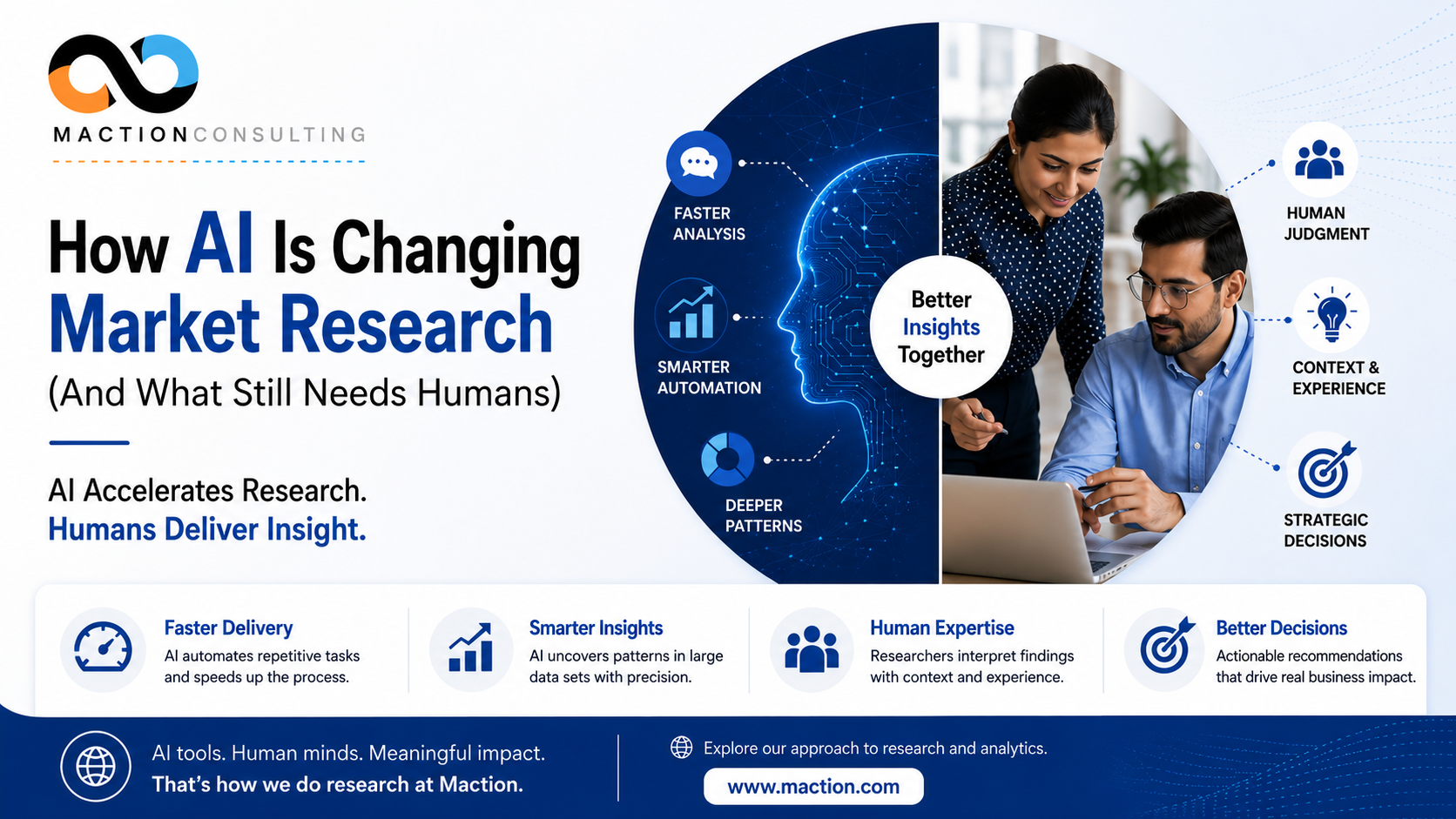

AI in market research is no longer experimental — it’s operational at some of the world’s largest agencies, reshaping how studies are designed, analysed, and delivered faster than most practitioners anticipated. From automated survey design and real-time text analytics to synthetic respondents and AI-generated reports, the technology has moved well beyond the pilot stage.
But the question that actually matters for businesses commissioning research is not how much AI a firm uses. It is whether AI is making the research better. And the honest answer is: sometimes yes, sometimes no — and it depends entirely on where AI is applied.
Where AI Is Genuinely Improving Market Research
1. Open-Ended Response Analysis
Coding and analysing verbatim responses from surveys has historically been one of the most time-consuming tasks in quantitative research. AI-powered natural language processing can now classify thousands of open-ended responses into themes in minutes — a task that previously took a team of coders several days.
When done well, this accelerates delivery without sacrificing analytical quality. When done poorly — with insufficient human review — it introduces classification errors that can misrepresent what respondents actually said.
2. Questionnaire Design Assistance
AI tools can now flag poorly worded questions, identify leading language, suggest routing logic, and estimate survey completion times before a questionnaire goes to field. For experienced researchers, this acts as a quality check. For less experienced teams, it can prevent common design errors that compromise data quality.
3. Faster Data Processing and Reporting
Automated tabulation, chart generation, and even first-draft narrative reporting are now possible at a fraction of the time and cost of manual production. For tracking studies with standardised report formats, this can dramatically reduce turnaround times and free up analyst time for interpretation rather than production.
4. Social Listening and Unstructured Data Mining
AI enables researchers to analyse millions of social media posts, reviews, and forum discussions to track brand sentiment, identify emerging issues, and monitor category conversations in near real-time. This complements — rather than replaces — primary research by providing a continuous signal between formal research waves.
Where Human Judgment Remains Irreplaceable
Research Design and Framing
AI cannot define the right research question. The most common failure in market research is not poor execution — it is asking the wrong question. Understanding a client’s business context, competitive landscape, decision-making timeline, and what the data will actually be used for requires human conversation and strategic judgment that no AI system currently replicates.
Moderating Qualitative Research
AI-moderated interviews are an emerging area, but the depth of insight from a skilled human moderator — who can read body language, probe ambiguity, and pursue unexpected threads in real time — remains significantly higher. Qualitative research, done well, is a human discipline.
Interpreting Findings in Business Context
Data does not interpret itself. The most valuable output from a market research project is not a chart — it is a recommendation. Translating findings into strategy requires an understanding of the client’s organisation, market dynamics, and competitive pressures that AI tools do not possess.
What This Means for Businesses Commissioning Research in India
For clients evaluating market research agencies, the right question is not “do you use AI?” — most serious firms do in some capacity. The right questions are:
- Which specific parts of the research process are AI-assisted, and how is quality controlled?
- What human expertise sits behind the AI outputs?
- Does the technology accelerate delivery or replace analytical depth?
India’s research market is diverse. Some firms are integrating AI responsibly to improve speed and scale. Others are using it as a marketing claim with little substance behind it. Asking these questions will quickly reveal which is which.
Frequently Asked Questions
Does AI replace human researchers in market research?
No. AI accelerates data processing, coding, and reporting — but research design, qualitative moderation, and strategic interpretation remain human-led tasks that AI cannot replicate.
Is AI-generated market research data reliable?
It depends on human oversight. AI-assisted coding and analysis are reliable when reviewed by experienced researchers, but unsupervised AI classification can introduce errors that misrepresent respondent intent.
What should I ask a research agency about their AI usage?
Ask which specific parts of the process are AI-assisted, what quality controls exist, and whether AI is accelerating delivery or substituting for analytical depth.
The Takeaway
AI is making certain parts of market research faster, cheaper, and more scalable. But the foundation of good research — asking the right question, designing rigorous methodology, and translating data into business decisions — remains a fundamentally human endeavour.
At Maction Consulting, we integrate AI-powered tools where they genuinely improve research quality and speed, while maintaining the human expertise that turns data into insight. To learn more about how Maction blends AI-powered tools with human research expertise, explore our Data Analytics services or get in touch with our team.