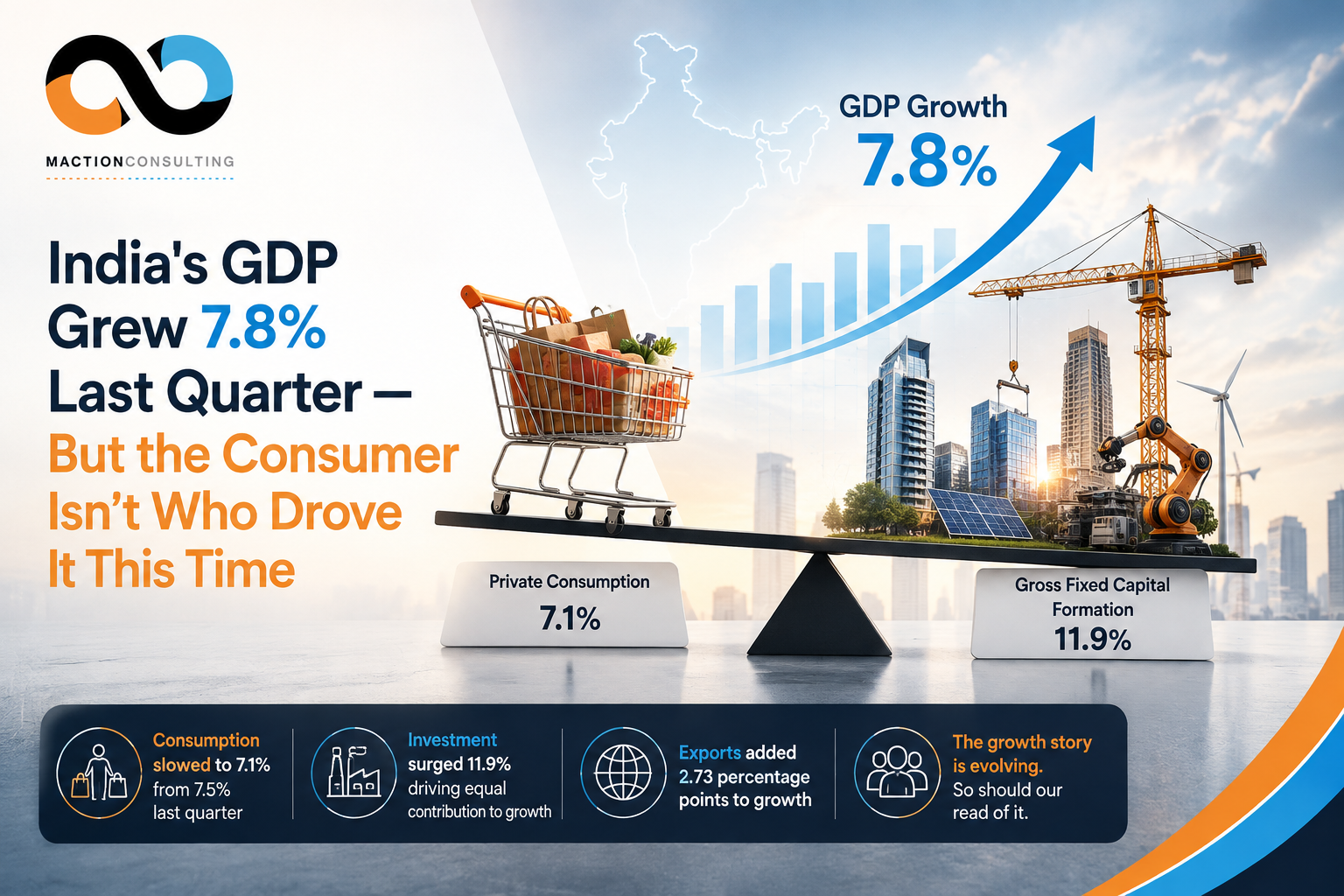

India’s GDP grew 7.8% in the April-June quarter, comfortably beating the RBI’s own 7% forecast, and most of the coverage this week has understandably led with that headline number. The detail worth sitting with is one line down in the official data: private consumption — every household in the country, buying everything it bought — grew 7.1%, a deceleration from 7.5% the quarter before. Investment, meanwhile, surged 11.9%, roughly double its pace from a year earlier. For a growth story that’s been narrated the same way for the better part of a decade — the consumer does the work, government builds, investment eventually shows up — this quarter quietly rewrote the sentence.
The Number That Should Get More Attention Than the Headline
Break the 7.8% growth figure down by who actually supplied it, and something genuinely unusual shows up: private consumption contributed 3.95 percentage points to growth, and gross fixed capital formation — factories, machines, warehouses, infrastructure — contributed exactly the same, 3.95 percentage points, matching to the second decimal place. Exports added a further 2.73 points, government consumption a modest 0.47. For a country where consumer spending has reliably been the largest single engine of growth, having investment draw level with it in the same quarter is the kind of structural shift that deserves more attention than it’s getting in the topline coverage.
Consumption Isn’t Weak — It’s Just Not Accelerating
It’s important to be precise about what this data does and doesn’t say. Private consumption g rowing 7.1% is still a healthy number by most standards, and it’s above the trailing eight-quarter average of 6.8%. This isn’t a consumption collapse. What it is, is a mild deceleration at the exact moment investment more than doubled its pace — and a slight dip in private consumption’s share of nominal GDP, down to 55.6% from 55.8% a year earlier. Small movements, but directionally consistent: the household is still spending, just not accelerating as fast as the rest of the economy around it is.
Where the Investment Surge Is Actually Coming From
The investment acceleration isn’t purely a government infrastructure push, which is the assumption this kind of number usually invites. Economists tracking the breakdown point specifically to private capital expenditure in data centres, power, and metals as major contributors alongside continued public capex — aggregate capital expenditure by the Centre, states, and public sector enterprises grew 16.9% this quarter, up from 14.1% a year earlier, but private investment is genuinely part of the story too, not just government spending dressed up as a national number. That distinction matters for demand forecasting: data centre and power-sector capex creates jobs and income in specific places and specific skill categories, not evenly across the consumer base the way a broad-based consumption boom would.
What This Means for How Category Trackers Should Read the Next Two Quarters
A GDP print led by investment rather than consumption has a different transmission timeline into household spending than a consumption-led quarter does. Investment-driven growth tends to show up in consumer demand with a lag — through job creation, wage growth in specific sectors, and downstream supplier activity — rather than showing up immediately in retail footfall or discretionary spend the way a direct consumption boost would. Brands reading this quarter’s strong GDP number as an immediate green light for aggressive festive-season demand assumptions should treat that read with some caution: the 7.8% headline is real, but a meaningful share of it isn’t consumer spending, and won’t necessarily convert into consumer spending on a fast timeline.
The Part of the Data Worth Testing Directly
- Separate GDP-driven optimism from consumption-driven optimism in category outlooks. A strong national growth number and a strong household spending outlook are not the same claim this quarter — treat them as two separate hypotheses to test rather than one confirming the other.
- Watch whether investment-led job creation reaches your category’s consumer base. Data centre, power, and metals capex creates income in specific geographies and skill segments — understanding whether that income growth overlaps with your brand’s core customer base is a real segmentation question, not a given.
- Track the consumption deceleration alongside inflation data, not in isolation. A private consumption slowdown from 7.5% to 7.1% lands in the same quarter that retail inflation has been climbing toward a 19-month high — worth testing whether these two trends are connected in your category’s consumer base or moving independently.
- Treat the strong headline GDP number as a macro tailwind, not a category-specific signal. Economists themselves are flagging that informal-sector measurement gaps and income-distribution questions complicate what the topline number actually captures — a reminder that category-level research, not the national print, is what should drive brand-specific decisions.
Frequently Asked Questions:
Q: What drove India’s 7.8% GDP growth in Q1 FY27?
India’s Q1 FY27 GDP growth of 7.8% was driven by an unusual balance between private consumption and investment. Private consumption contributed 3.95 percentage points to growth, while gross fixed capital formation — factories, machines, infrastructure — contributed an identical 3.95 percentage points. Exports added 2.73 points. This is the first time in recent quarterly data that investment has matched consumption as a growth driver, marking a structural shift from India’s typically consumption-led growth pattern.
Q: Why did private consumption decelerate in Q1 FY27?
Private consumption grew 7.1% in Q1 FY27, a slight deceleration from 7.5% the prior quarter — and a dip in its share of nominal GDP from 55.8% to 55.6%. This isn’t a consumption collapse but a mild slowdown occurring at the same time retail inflation has been climbing toward a 19-month high. Whether these two trends are connected — inflation constraining consumption growth — or moving independently varies by category and consumer segment.
Q: What is driving India’s investment surge in Q1 FY27?
The investment acceleration reflects both public and private capex. Aggregate capital expenditure by the Centre, states, and public sector enterprises grew 16.9%, up from 14.1% a year earlier. Private investment in data centres, power, and metals is also a significant contributor — not just government infrastructure spending. This distinction matters for demand forecasting because sector-specific capex creates income in specific geographies and skill categories, not evenly across the consumer base.
Q: What does investment-led GDP growth mean for festive season consumer demand?
Investment-driven growth transmits into household consumer spending with a lag — through job creation, wage growth in specific sectors, and downstream supplier activity. Brands reading Q1 FY27’s strong 7.8% GDP number as an immediate green light for aggressive festive-season demand assumptions should treat that read with caution. A meaningful share of the growth isn’t consumer spending and won’t convert into consumer spending on a fast timeline.
The Bigger Point
A 7.8% GDP print beating the RBI’s own forecast is genuinely good news for India’s economy, and it’s a legitimate positive signal heading into the festive season. But the composition of that growth — investment matching consumption for the first time in a decade of quarterly data most analysts can recall — means the strength isn’t distributed the way headline coverage implies. Brands building H2 demand assumptions off “the economy grew 7.8%” without looking at who actually supplied that growth risk overestimating how quickly it reaches the consumer’s wallet.
If you want a category-level read on how this quarter’s investment-led growth is likely to reach your consumer base, talk to our research team at Maction.