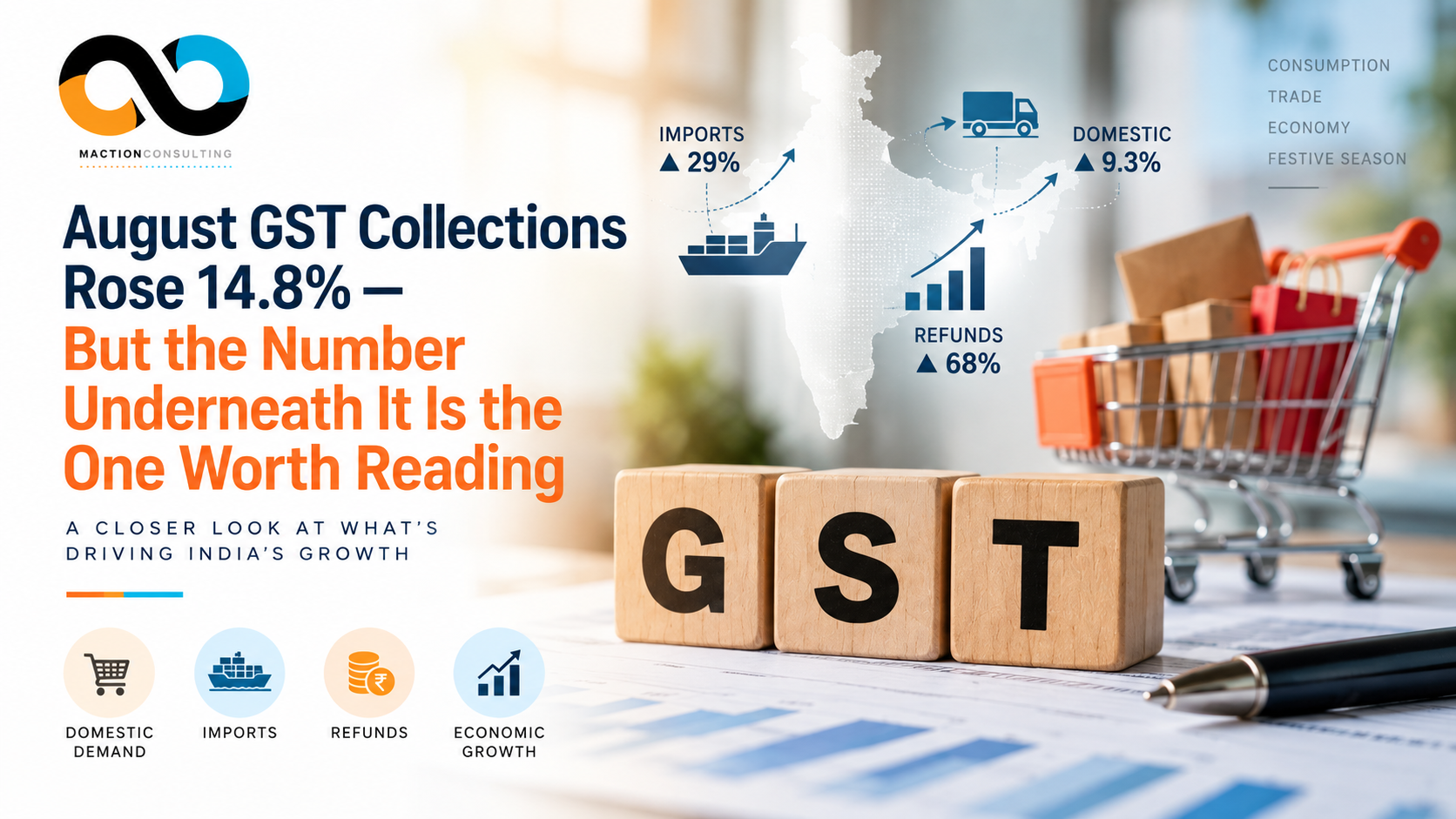

India’s gross GST collections came in at ₹1,99,853 crore for August, released September 1 — a healthy-looking 14.8% jump over last year, edging right up to the ₹2 lakh crore mark. On a headline basis, that’s a positive signal just as brands finalise festive-season plans. Sitting inside that number, though, is a detail that changes the read: the growth wasn’t broadly domestic-consumption-led. Import-related GST revenue surged 29% year-on-year, while domestic GST revenue grew a comparatively modest 9.3% — and after accounting for a 68% jump in refunds, net GST revenue growth for the month was just 8.3%, less than half the headline gross figure.
Gross, Net, and the Growing Gap Between Them
The gap between gross and net GST growth this month is unusually wide, and it’s worth understanding why before treating the 14.8% headline as a clean consumption signal. Refunds jumped 67.9% year-on-year to ₹31,795 crore, a sharp enough rise that it meaningfully changes the story: gross collections grew nearly 15%, but the revenue actually retained by the government grew closer to 8%. For research purposes, gross GST collections are frequently used as a rough proxy for economic and consumption activity — but a month where refunds nearly doubled is a month where that proxy needs a closer look before being taken at face value.
Imports Are Doing More of the Work Than Domestic Demand Is
The more direct signal for consumer research is the domestic-versus-import split. Domestic GST revenue — the component most directly tied to what Indian consumers and businesses are buying and selling within the country — grew 9.3% in August, moderating from the stronger 15.4% pace recorded in July. Import GST, by contrast, grew 29%, making it the fastest-growing component of the month’s collections by a wide margin. A GST print led disproportionately by import activity rather than domestic transactions is a materially different signal for consumer demand than one led by domestic growth, even when the two produce a similar-looking headline number.
Buoyancy Below One Is the Number Economists Are Actually Watching
For the April-August period of this fiscal year, net GST revenue growth on a year-to-date basis has come in at roughly 9%, with GST buoyancy — a measure of how fast tax revenue grows relative to nominal GDP growth — sitting at around 0.7. A buoyancy figure below 1 means GST collections are growing more slowly than the overall economy, which is a meaningfully different picture than the “strong GST growth” framing most headlines are running with. It doesn’t mean consumption is contracting, but it does mean tax collections aren’t keeping pace with broader economic growth, and that gap is worth tracking as its own indicator rather than assuming GST growth and GDP growth are moving in lockstep.
Why This Print Matters More Than a Typical Month
August is the last full monthly GST data point available before the Big Billion Days and Great Indian Festival sales, and before the broader Navratri-to-Diwali festive window that typically drives the single largest GST and retail spending surge of the year. A domestic GST growth rate that’s moderating from July’s pace, even as the headline number looks strong, is a useful — if quiet — data point for calibrating festive demand expectations. It doesn’t contradict the Q1 FY27 GDP data showing investment matching consumption as a growth driver; if anything, it reinforces the same underlying story: the growth in the system right now isn’t purely a domestic-household-spending story, and treating it as one risks overestimating how much of it reaches retail shelves this festive season.
What to Watch and Test Going Into September’s Data
- Track domestic GST growth specifically, not the gross headline, when using GST data as a proxy for consumer demand in category planning — the 9.3% domestic figure is the more relevant number than the 14.8% gross figure for most consumer-facing categories.
- Watch whether September’s GST data shows domestic growth reaccelerating, since September collections will start to capture early festive-season buying ahead of the October sales window, making it the first real read on whether festive demand is tracking to expectations.
- Treat the refund surge as a data-quality flag, not just a technical footnote. A 68% jump in refunds in a single month is unusual enough that it’s worth understanding whether it reflects a policy or processing change, rather than assuming it’s a one-off.
- Cross-reference against the Q1 FY27 GDP investment-consumption split, since both data points this month are pointing toward the same underlying pattern — genuine economic strength that isn’t purely, or even primarily, being driven by domestic household consumption.
Frequently Asked Questions
Q: What were India’s GST collections in August 2026?
India’s gross GST collections for August 2026 came in at ₹1,99,853 crore — a 14.8% year-on-year increase, just below the ₹2 lakh crore mark. However, the headline figure masks significant variation underneath: domestic GST revenue grew just 9.3%, import GST surged 29%, and refunds jumped 67.9% to ₹31,795 crore — reducing net GST revenue growth to approximately 8.3%.
Q: What is GST buoyancy and why does it matter?
GST buoyancy measures how fast GST revenue grows relative to nominal GDP growth. A buoyancy figure below 1 means GST collections are growing more slowly than the broader economy. For the April-August period of FY27, GST buoyancy is running at approximately 0.7 — meaning the tax system is not keeping pace with overall economic growth, a more measured picture than the gross collection headlines suggest.
Q: Why is the domestic vs import GST split important for consumer research?
Domestic GST revenue — tied directly to what Indian consumers and businesses are buying and selling within the country — is the more relevant signal for consumer demand. Import GST reflects cross-border trade activity rather than domestic consumption. When import GST grows at 29% while domestic GST grows at 9.3%, the headline composite figure overstates the strength of domestic consumer demand.
Q: What does August’s GST data mean for festive season demand planning?
August is the last full monthly GST data point before the Big Billion Days and Navratri-to-Diwali festive window. A domestic GST growth rate moderating from July’s 15.4% to 9.3% in August — even as the headline looks strong — is a useful calibration for festive demand expectations. Combined with Q1 FY27 GDP data showing investment matching consumption, the pattern suggests economic strength that isn’t flowing purely through domestic household spending.
The Bigger Point
A 14.8% GST growth headline right before the festive season is the kind of number that’s easy to read as unambiguous good news for consumer demand. The data underneath it — a much smaller domestic growth figure, a sharp refund surge that halves the net growth rate, and buoyancy running below the pace of the broader economy — tells a more measured story, one that lines up closely with what this quarter’s GDP data has already shown: real strength in the Indian economy right now, but strength that isn’t flowing through domestic consumption as directly as the topline numbers suggest. Brands finalising festive-season plans on the strength of a single GST headline are working with an incomplete picture.
If you want a clearer, category-specific read on festive demand ahead of the sales season, talk to our research team at Maction.