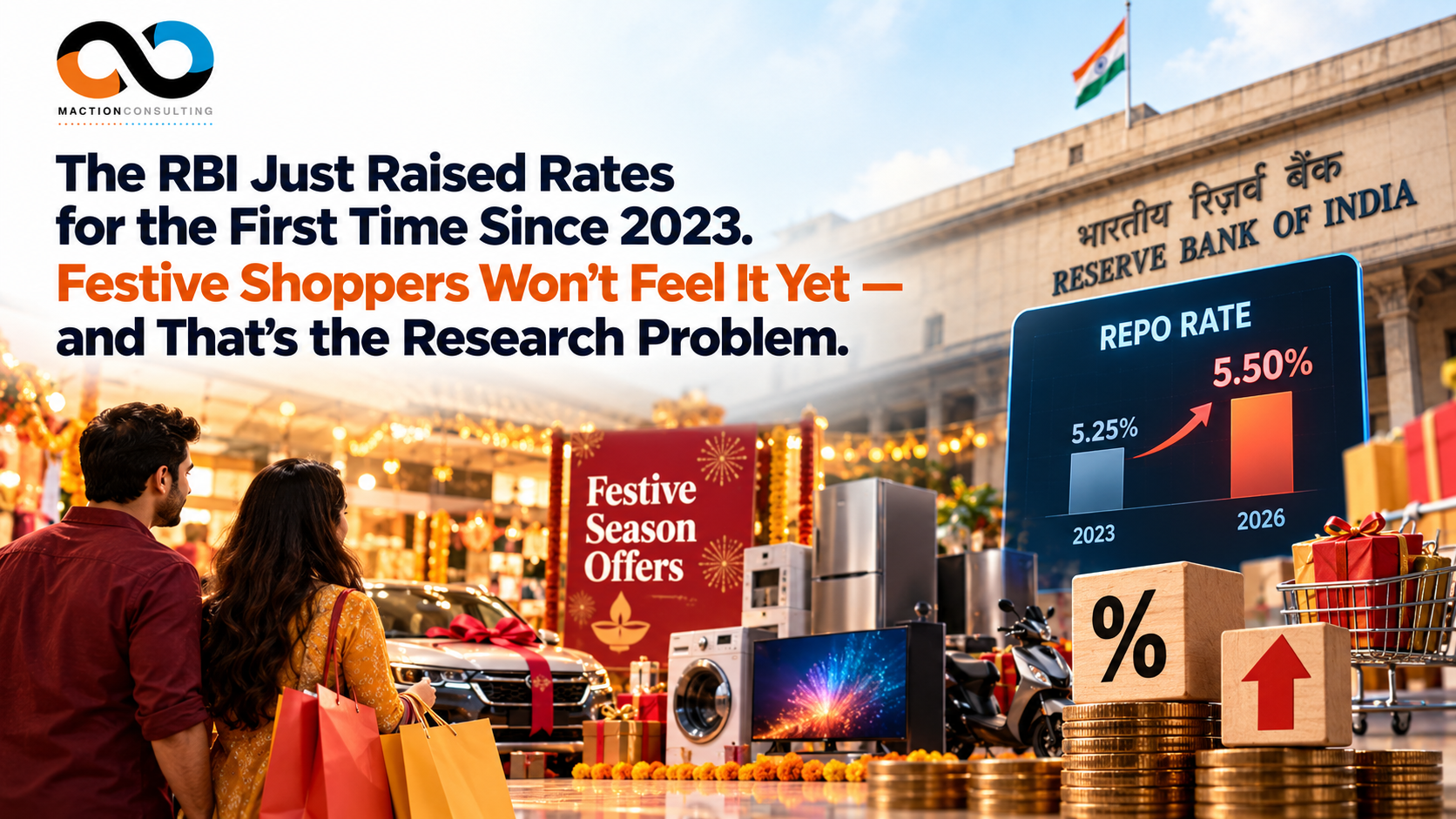

On October 7, the RBI’s Monetary Policy Committee voted unanimously to raise the repo rate by 25 basis points to 5.50% — the first increase since February 2023 — and shifted its stance from neutral to calibrated tightening. The committee’s own explanation of that stance is blunt: rate cuts are off the table in the near term, and the next move is either another hike or a pause. The decision landed days before Navratri begins on October 11, and a month before Dhanteras on November 6. For any brand planning, running or measuring a festive campaign, the timing is the story.
What the RBI Actually Said Beyond the Headline
The rate hike is the part everyone will report. The inflation reasoning behind it is the part worth reading. CPI inflation rose to 4.8% in August from 4.5% in July, and core inflation moved up to 4.2%, which the RBI reads as a sign that price pressure is widening rather than staying confined to food and fuel. About 37% of the CPI basket by weight is now running above 4%, and food price increases have become more broad-based, with sugar and onion singled out for notable spikes (a pattern we looked at in our onion buffer stock analysis).
The forward view is what makes the festive window uncomfortable. The RBI projects FY2026-27 CPI inflation at 5.2%, with the October-December quarter peaking at 6.0% and the January-March quarter at 5.7%. Growth, meanwhile, is not the problem: Q1 GDP came in at 7.8%, and the full-year projection was set at 7.1%. This is a central bank tightening into strength, not into weakness. One more detail matters for reading the signal: the stance change passed 4-2, with two members preferring to stay neutral, and the minutes on October 21 will show how they reasoned.
The Timing Gap Nobody Is Measuring
Here is the research problem. The signal reached consumers on October 7. The cost, for most of them, has not. Fresh loans are priced off the new rate immediately, but existing floating-rate borrowers see the change only when their loan resets, which depends on the lender and the loan agreement. Deposit rates adjust gradually. Fixed-rate borrowers and anyone paying in cash feel nothing directly at all.
That means the festive season sits inside a gap between the announcement and the actual pass-through. During that gap, behaviour is driven by what shoppers believe will happen to their loan costs, not by what has happened. A standard festive tracker that records spend and category share will capture the outcome but miss the mechanism entirely.
To put the actual money in perspective, an illustrative example: on a Rs 50 lakh, 20-year home loan, a move from 8.5% to 8.75% adds roughly Rs 800 to the monthly EMI. That is unlikely to change a purchase decision on arithmetic alone. Whether the signal itself changes decisions is the open question.
Three Hypotheses Worth Testing This Festive Season
These are hypotheses to test, not predictions.
Pull-forward. If shoppers read “calibrated tightening” as more hikes coming, financed big-ticket purchases (cars, two-wheelers, appliances, home upgrades) may move into this festive window rather than wait for costlier credit in 2027.
Caution and postponement. The same signal, layered on top of a projected 6.0% inflation peak in the festive quarter, could read as a reason to hold back. We have already seen selective, deliberate spending in this year’s data, which we covered in our calibrated consumption analysis, and a rate hike is a natural trigger for more of it.
Offer-led substitution. No-cost EMI and similar financing offers are typically funded by the brand or the retailer. Higher funding costs make those offers more expensive to sustain, so it is worth watching whether they get shorter, narrower or quietly withdrawn, and whether shoppers notice or care when they do.
Where It Reaches First, and Where It Doesn’t
Finance-led categories feel this first: housing, autos, two-wheelers, consumer durables and personal loans. Cash-led categories such as everyday FMCG feel the inflation side of the story far more than the credit side. The RBI also flags the deficient monsoon and strong El Niño conditions as risks to agriculture and rural demand, which matters for any brand with a rural festive push.
Seen together, the squeeze is layered: higher prices, costlier credit, a weaker rural outlook, a rupee under pressure and, from October 15, a new cost on UPI for merchants. None of these alone breaks festive demand. The research value is in understanding which consumers and which categories feel the combination first.
What to Build Into Research Now
- Measure expectation separately from exposure. Ask whether respondents believe their loan costs will rise, independent of whether they actually hold floating-rate debt. In the gap before pass-through, the belief is what moves behaviour.
- Split financed purchases from cash purchases in any festive tracker. A blended number will hide the segment where rate sensitivity actually shows up.
- Test EMI offer sensitivity. Check whether no-cost EMI messaging still moves conversion, and whether shoppers can tell a subsidised offer from a standard one.
- Time your waves around known dates. The MPC minutes on October 21, Dhanteras on November 6 and the next policy meeting on December 2-4 give a natural before-and-after design.
- Read it alongside price pressure, not in isolation. Track trade-down and pack-size shifts in the October-December quarter, when the RBI expects inflation to peak.
Frequently Asked Questions
Q: Why did the RBI raise the repo rate in October 2026?
The MPC pointed to inflation that is no longer benign: headline CPI projected to average close to 5.8% over the next three quarters, core inflation at 4.2% and rising, a deficient monsoon, and elevated energy prices tied to the West Asia conflict. It also noted strong growth and credit expansion, which gave it room to tighten.
Q: How will the rate hike affect festive season demand in India?
The direct cost impact will be gradual, since most existing floating-rate borrowers only see it at their next reset. The more immediate effect is likely to be on sentiment and expectations, which can pull financed purchases forward or push them back depending on how shoppers read the signal. That is exactly why it needs to be measured rather than assumed.
Q: When will borrowers actually see higher EMIs?
New loans are priced off the higher rate right away. Existing floating-rate loans change at their next scheduled reset, which varies by lender and loan agreement, and some lenders adjust tenure rather than the EMI amount. Fixed-rate loans are unaffected until they are refinanced.
Q: What should consumer durables and auto brands research before Dhanteras?
Four priorities: separate financed buyers from cash buyers, measure what shoppers expect to happen to their loan costs, test how sensitive conversion is to EMI-led offers, and track whether any pull-forward in demand is real or just a shift in timing within the same season.
The Bigger Point
A rate hike in the middle of the festive run-up is easy to file under macroeconomics and move on. But the more useful reading is behavioral: for the next several weeks, consumers are making decisions on an announcement, not on a bill. How they interpret that announcement, whether as urgency, as caution or as noise, will shape festive outcomes in the categories most dependent on credit. The brands that find out early will adjust offers and messaging while the season is still running.
If you want to understand how rate expectations are shaping purchase decisions in your category this festive season, talk to our research team at Maction.