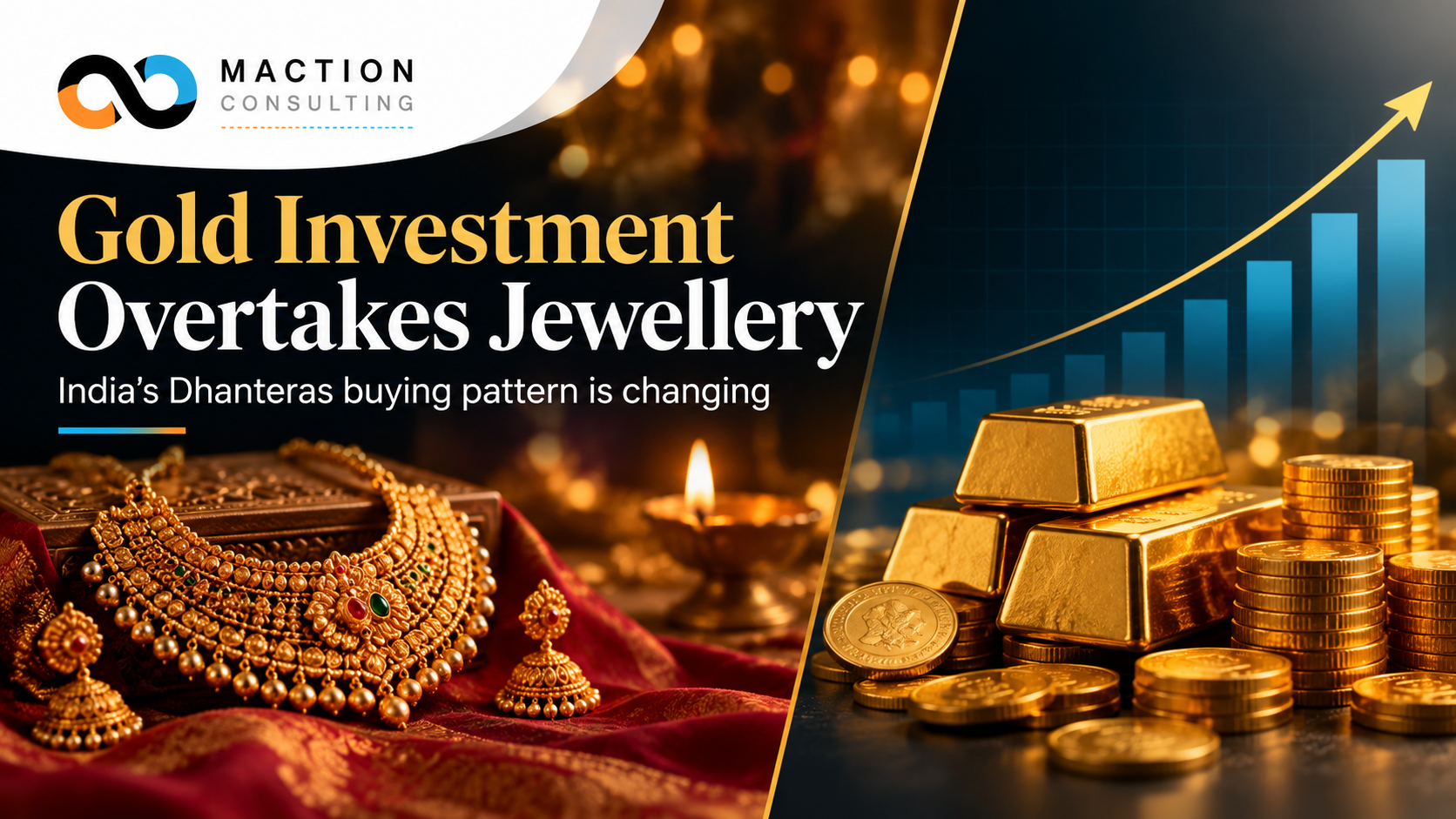

Dhanteras falls on November 6 this year, exactly a month away, and the World Gold Council’s own data points to something that would have sounded implausible a few years ago: in the first quarter of 2026, gold investment demand overtook jewellery demand in India for the first time since 2000. Bar and coin investment made up 52% of total domestic gold demand, the highest share on record since 2013, up from 42% a year earlier, even as jewellery’s share fell to a record low 44%. This isn’t a marginal shift in a niche segment. It’s a reversal of the purchasing pattern that has defined India’s relationship with gold for a quarter of a century, and it’s happening in the exact category — gold — that most reliably anchors Dhanteras research every year.
The Price Math Behind the Shift
Gold’s 2026 price trajectory explains most of why this is happening. Domestic prices started the year around Rs 1.40 lakh per 10 grams, peaked near Rs 1.79 lakh, corrected, then climbed again after a May import duty hike pushed India’s effective tax stack on gold to roughly 19% — a 15% Basic Customs Duty, a 1% Agriculture Infrastructure cess, a social welfare surcharge, and 3% GST layered on top of the international price and rupee exchange rate. Forecasts for Dhanteras itself cluster in a wide Rs 1.6 lakh to Rs 1.9 lakh per 10 grams range. Layered onto that base price, jewellery carries an additional 10-20% in making charges that a bar or coin doesn’t — which means at today’s prices, the gap between buying gold as jewellery and buying it as a pure investment has widened into a genuinely consequential cost difference, not a marginal one.
Why This Matters Beyond the Jewellery Trade
For a jewellery or gems retailer, this shift is the headline story on its own. But the more interesting research question sits one layer deeper: what does it mean that a culturally embedded, emotionally anchored purchase — gold jewellery for Dhanteras, often tied to specific family or wedding occasions — is losing share to a comparatively unsentimental, purely financial product like a bar or coin? That’s a meaningful signal about how far price sensitivity can push consumers away from occasion-driven, emotionally motivated buying when the cost gap becomes large enough. Gold may be a uniquely extreme case given how directly price-transparent it is, but the underlying mechanism — rational, financially-driven substitution displacing a traditional, occasion-anchored purchase — is worth testing in any category where a brand assumes festive purchase decisions are purely driven by sentiment and tradition rather than price calculation.
The Industry’s Own Response Is a Research Signal
Jewellers aren’t treating this as a temporary blip — they’re actively retooling to meet it. Reporting from last year’s Dhanteras already described the industry offering healthy discounts on making charges specifically to keep jewellery competitive against coins and bars, and pushing lighter jewellery pieces and smaller-weight items to keep absolute price points within reach. That’s a direct, observable adaptation to a price-driven trade-down pattern, playing out in real time within a single category — and a useful case study for any brand watching its own premium or traditional-format products lose share to a lower-cost substitute under sustained price pressure.
Volume Down, Value Up — A Pattern Worth Recognising Elsewhere
Gold demand data consistently shows volume falling even as total spend rises to record levels — a pattern this year’s FMCG earnings data also showed, where price-led revenue growth masked a more complicated volume picture underneath. The two categories are nothing alike on the surface, but the underlying research discipline is identical: a strong headline revenue or spend number, driven primarily by price rather than volume, tells a fundamentally different demand story than the same headline number driven by more units sold. Any festive-season category tracker that reports only value growth risks missing exactly this kind of divergence, in gold and well beyond it.
What to Build Into Research Ahead of Dhanteras
- Separate volume and value explicitly in any category showing strong festive spend growth, since a value number alone can mask a genuine volume decline — gold’s own data makes this distinction unusually visible this year.
- Test the price point at which occasion-driven buying actually breaks down, in categories beyond gold. The investment-over-jewellery shift suggests there’s a real, identifiable threshold where price sensitivity overrides tradition-driven purchase motivation — worth mapping for your own festive-relevant category rather than assuming sentiment always wins.
- Watch how competitors are adapting format and pricing, not just price itself, the way jewellers are shifting toward lighter pieces and discounted making charges — a format or portion-size adaptation can be a more telling signal of underlying price pressure than a headline discount.
- Track whether this shift is gold-specific or part of a broader festive-spending caution, by cross-referencing against the “calibrated consumption” pattern already showing up in this year’s broader consumer sentiment data — selective, deliberate spending rather than either free spending or outright pullback.
Frequently Asked Questions
Q: How is gold performing as an investment ahead of Dhanteras 2026?
Gold crossed Rs 81,000 per 10 grams before Dhanteras 2026 — up approximately 28% year-on-year and outperforming most major equity indices over the same period. This makes gold simultaneously more expensive as a jewellery purchase and more attractive as an investment, creating two distinct buyer motivations at the same retail counter during the same festive window.
Q: How are high gold prices affecting jewellery buying at Dhanteras 2026?
High prices are producing two distinct effects. Grammage-sensitive buyers — primarily those making occasion-driven purchases for personal wear or gifting — are trading down to lighter pieces, smaller designs, or lower karatage. Investment-motivated buyers are more price-tolerant and in some cases increasing volume, reasoning that price appreciation makes the purchase worthwhile beyond its ornamental value. Treating Dhanteras gold buyers as one segment misreads both groups.
Q: Are Indian consumers shifting from physical gold to digital gold and ETFs?
Yes — meaningfully. Gold ETF and sovereign gold bond volumes have grown significantly, and digital gold platforms have made fractional gold investment accessible to a much broader buyer base. Some portion of Dhanteras gold buying that would previously have gone to physical jewellery or coins is now flowing into digital instruments. Jewellery brands cannot easily capture this with in-store research — it requires understanding the full gold investment consideration set, including alternatives.
Q: What should jewellery brands research before Dhanteras 2026?
Four priorities: separate investment-motivated from occasion-motivated buyers directly in research design — they respond to different messaging and pricing prompts; test grammage sensitivity at your specific price points; understand what share of your target segment is considering digital gold or ETFs as an alternative; and track whether high prices are bringing in a new, investment-oriented buyer profile or simply concentrating existing buyers into fewer transactions.
The Bigger Point
A quarter-century-old purchasing pattern reversing in a single year is the kind of structural shift that’s easy to read as specific to gold’s unusual price dynamics — and in large part, it is. But the mechanism underneath it, a traditional and emotionally anchored festive purchase losing ground to a more price-rational alternative once the cost gap gets wide enough, is a pattern worth testing well beyond jewellery stores. Dhanteras is a month away, and the question worth researching now isn’t just how much gold India will buy — it’s whether other festive categories are approaching a similar tipping point that hasn’t become visible yet.
If you want to understand where your category’s festive purchases sit on the tradition-versus-price-sensitivity spectrum, talk to our research team at Maction.