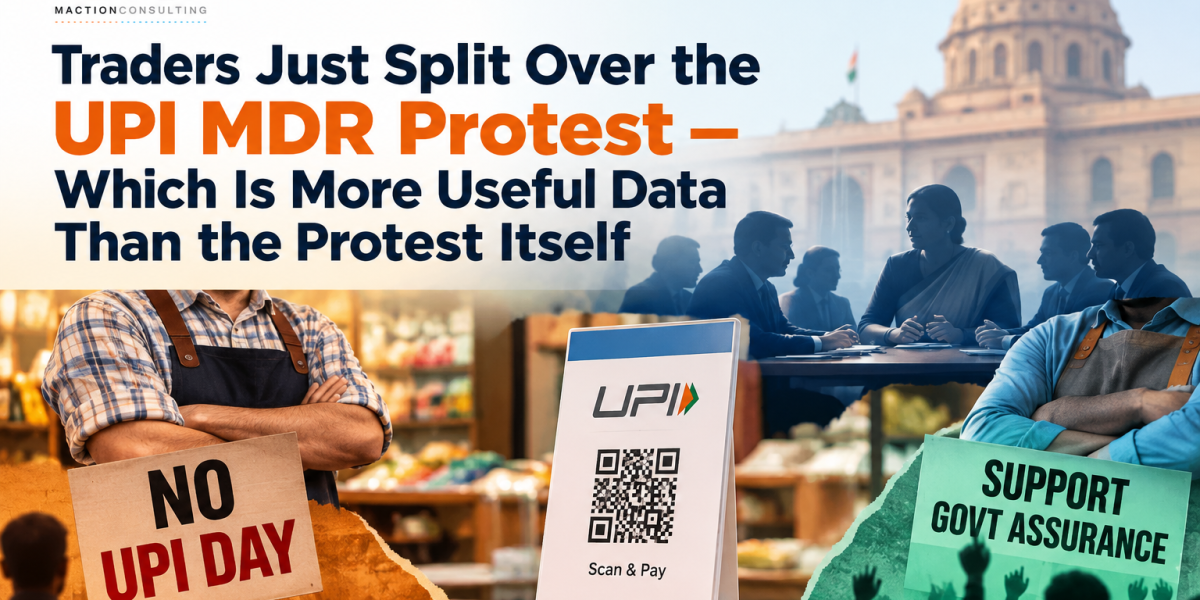


NPCI issued a circular on September 15 that ends six years of zero-cost UPI for merchants. From October 15, a 0.4% Merchant Discount Rate applies to person-to-merchant transactions above Rs 2,000, capped at Rs 300 per transaction. Person-to-person transfers stay free, payments up to Rs 2,000 stay free, and small merchants below Rs 1 lakh in monthly volume are exempt — the government’s estimate is that over 95% of P2M transactions are unaffected. Consumers pay nothing extra, and merchants are explicitly barred from passing the cost on. All of that is true, and all of it is being widely reported. What’s getting less attention is the date: October 15 falls squarely inside the Navratri-to-Diwali window, meaning India’s biggest retail season will run under payment economics that change midway through it.
What Actually Changes
| Transaction Type | MDR Charged to Merchant |
| Person-to-person (any amount) | Nil |
| Merchant payment up to Rs 2,000 | Nil |
| Micro-merchants (under Rs 1 lakh/month) | Nil |
| Standard merchant, above Rs 2,000 | 0.4%, capped at Rs 300 |
| Utilities, railways, telecom, fuel | Flat Rs 5 per transaction |
NPCI’s proposed distribution sends 40% of the MDR to the issuing bank, 30% to the consumer-side app, and 30% to the acquiring side, with 5% of collections set aside in a dedicated fund supporting small merchants. The Finance Ministry has been unambiguous that this is a charge within the merchant payment ecosystem rather than a charge on customers, and is reportedly setting up a monitoring mechanism specifically to prevent the burden being pushed onto buyers.
The Rs 2,000 Threshold Is the Research Question
A hard threshold at Rs 2,000 creates an obvious behavioural incentive at the margin, and that’s where the interesting consumer and merchant research sits. A merchant facing a Rs 12 charge on a Rs 3,000 sale has a few options that don’t involve raising the price: encourage cash for larger baskets, split a transaction into two payments under the threshold, or steer the customer toward a different payment rail entirely. None of these are things a merchant would advertise, and none would show up in a standard sales tracker — but all of them would change what a brand sees in its own transaction data if they happen at scale.
The threshold also sits at a genuinely consequential price point for festive retail. A Rs 2,000 line separates most FMCG and grocery baskets from apparel, footwear, small appliances, and gifting purchases — precisely the categories that spike during Navratri and Diwali. For a brand selling mostly below that line, this is close to a non-event. For one selling mostly above it, the merchant partners and retailers stocking its products are absorbing a new cost at their busiest moment of the year.
Why Mid-Season Timing Matters More Than the Rate Itself
Navratri begins October 11 and Dussehra falls on October 20, with Diwali following in November. An October 15 implementation date means merchants will trade under one set of payment economics for the first stretch of the season and a different set for the remainder. For research purposes, that’s an unusually clean natural comparison — pre-October-15 and post-October-15 transaction behaviour, within the same season, same consumers, same categories. Brands with access to their own retail or channel-partner transaction data have a genuine window here to observe whether payment-mix or basket-size behaviour shifts, rather than speculating about it after the fact.
The Pass-Through Question the Rules Can’t Fully Settle
Merchants are prohibited from adding an MDR surcharge at checkout, and UPI apps are barred from imposing platform fees on top. Those are clear rules about explicit charges. What they can’t regulate is the quieter version: a small trader who nudges a customer toward cash on a larger purchase, or a retailer who factors the cost into a price revision at the next cycle rather than at the till. Whether that happens at any meaningful scale is an empirical question, not a policy one — and it’s the kind of thing that surfaces in merchant interviews and channel research long before it shows up in aggregate payment statistics.
What to Build Into Research Over the Next Two Months
- Segment your own category by the Rs 2,000 line before assuming this is a non-issue. Average basket value relative to that threshold determines almost entirely whether your channel partners are affected.
- Run merchant-side research, not just consumer-side. The behavioural change here happens at the counter, among retailers and small traders deciding how to handle a new cost — a segment most brand trackers don’t survey at all.
- Use October 15 as a natural before-and-after boundary, comparing payment mix, average transaction value, and basket composition on either side of the date within the same festive season.
- Watch for transaction splitting and cash nudging as measurable signals, particularly in categories where baskets cluster just above Rs 2,000 — a rise in paired sub-threshold transactions would be the clearest fingerprint.
- Separate merchant sentiment from merchant behaviour. Trade bodies have been vocal about exempting small merchants, but stated opposition and actual changes in payment acceptance are different things, and only one of them affects your sales data.
Frequently Asked Questions
Q: What is the UPI MDR change effective October 2026?
NPCI’s September 15, 2026 circular introduces a 0.4% Merchant Discount Rate on UPI person-to-merchant transactions above Rs 2,000, capped at Rs 300 per transaction, effective October 15, 2026. Person-to-person transfers remain free, payments up to Rs 2,000 remain free, and micro-merchants with monthly volumes below Rs 1 lakh are exempt. Consumers pay nothing additional — merchants are explicitly prohibited from passing the cost on to buyers.
Q: How does the Rs 2,000 UPI MDR threshold affect festive season retail?
The Rs 2,000 threshold falls at a consequential price point for festive retail — separating most FMCG and grocery baskets from apparel, footwear, small appliances, and gifting purchases that spike during Navratri and Diwali. Merchants facing a new cost on larger baskets have behavioural options: encouraging cash for transactions above the threshold, splitting transactions into two sub-Rs 2,000 payments, or steering customers toward alternative payment rails. None would be visible in standard sales trackers.
Q: Why does the October 15 UPI MDR launch date matter for brands?
October 15 falls inside the Navratri-to-Diwali festive window — four days after Navratri begins and five days before Dussehra. This means the festive season runs under two different sets of payment economics: before and after October 15. For brands with access to retail or channel-partner transaction data, this creates a natural before-and-after comparison within the same season to observe whether payment mix or basket size behaviour shifts.
Q: Can merchants pass the UPI MDR cost on to customers?
No. NPCI’s circular explicitly prohibits merchants from adding an MDR surcharge at checkout, and UPI apps are barred from imposing platform fees. However, what the rules cannot regulate is quieter behaviour — a trader nudging a customer toward cash on a larger purchase, or a retailer factoring the cost into a price revision at the next cycle rather than at the till. Whether this happens at meaningful scale is an empirical question that surfaces in merchant interviews, not aggregate payment statistics.
The Bigger Point
The government’s framing is accurate on its own terms: this is a narrow, capped charge that leaves the vast majority of UPI transactions untouched and costs consumers nothing directly. But narrow changes at specific thresholds tend to produce behaviour at exactly those thresholds, and this one arrives at the busiest retail moment of the Indian calendar, affecting precisely the transaction sizes that festive shopping generates. Brands treating this as a banking-sector story rather than a channel and merchant-behaviour question are likely to find out what changed only after the season is over.
If you want merchant-side or channel research on how the MDR change is affecting your category through the festive season, talk to our research team at Maction.