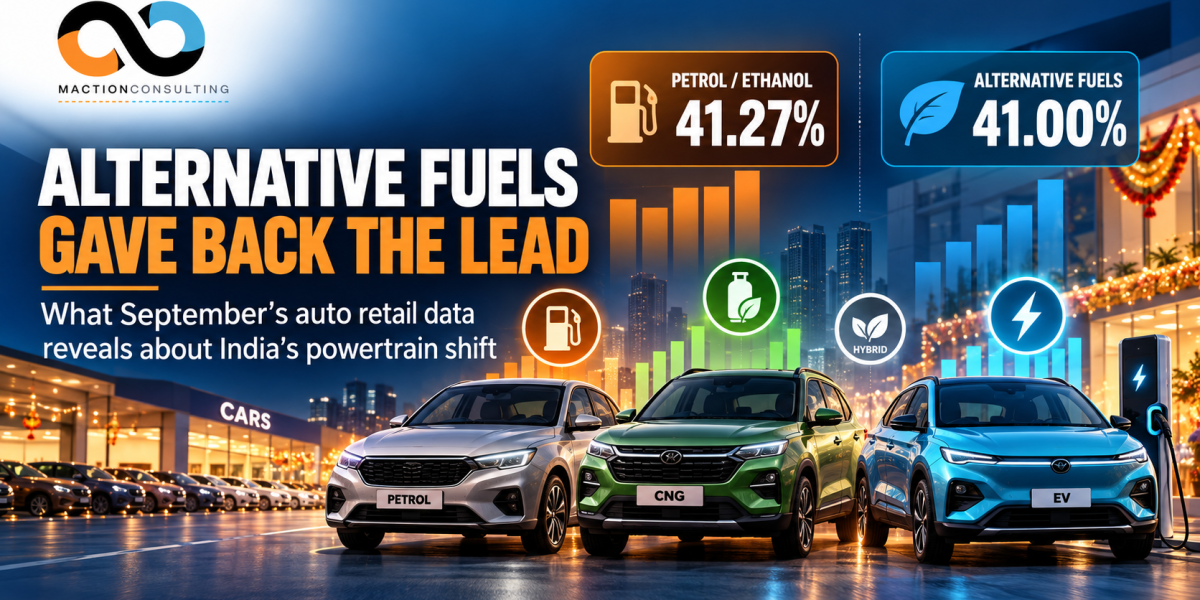
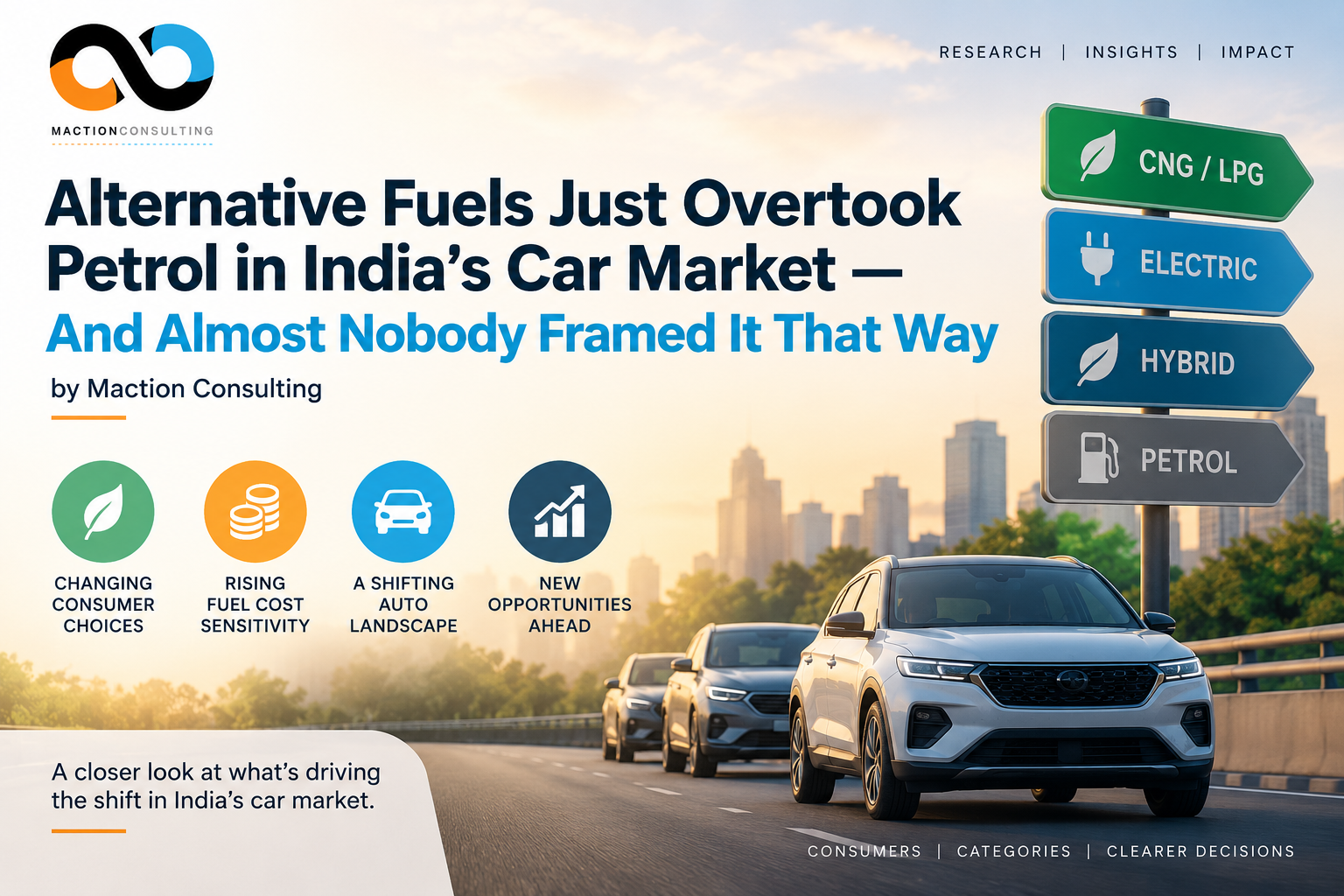

FADA’s August retail numbers, released September 7, led with a genuinely strong headline: 24.23 lakh vehicle registrations, up 17.51% year-on-year, the biggest August on record. That’s the number every outlet ran with. Buried a few paragraphs down is a line that matters more for anyone tracking consumer preference: CNG, hybrid, and electric vehicles combined accounted for 41.95% of passenger vehicle retail in August, edging past petrol and ethanol’s 40.85% share for the first time. FADA’s own president called it a structural shift. Most coverage treated it as a footnote to the topline sales number.
The Powertrain Mix, In Full
| Powertrain | Share of PV Retail, August 2026 |
| CNG / LPG | 25.28% |
| Petrol / Ethanol | 40.85% |
| Diesel | 17.21% |
| Hybrid | 9.04% |
| Electric | 7.63% |
The composition is worth sitting with. CNG and LPG alone, at 25.28%, are doing most of the work in the alternative-fuel category — this isn’t primarily an EV story, whatever the framing around “alternative powertrains” implies. Hybrids at 9.04% and pure electric at 7.63% are meaningful but still secondary contributors. That distinction matters enormously for anyone reading this as evidence of accelerating EV adoption specifically, rather than what the data actually shows: a broader move away from petrol as the default choice, with CNG doing the heavy lifting.
Why CNG, Not EVs, Is the Real Story Here
A crossover driven mainly by CNG rather than EVs points to a different underlying consumer motivation than the one usually assumed. EV adoption narratives tend to center on environmental consideration, technology enthusiasm, or urban early-adopter behaviour. CNG adoption at this scale is a more straightforwardly economic decision — running cost per kilometre is the primary driver, not positioning or image. A crossover led by CNG suggests the shift away from petrol right now is being driven more by cost-of-ownership calculation than by any of the narratives usually used to explain “alternative fuel” growth, and that has real implications for how a brand should message a CNG or hybrid variant versus how it messages an EV.
This Crossed the Line in the Same Month Fuel Costs Have Been a Live Story
The timing lines up with a pattern that’s been building through this year’s coverage of West Asia-linked fuel volatility and climbing retail inflation. A consumer becoming more sensitive to running costs on a big-ticket, multi-year purchase like a car is a plausible, fairly direct response to a year where fuel and transport costs have been unusually visible and unusually volatile. It’s a hypothesis rather than a confirmed causal link from this data alone, but it’s a genuinely testable one — and if it holds, it means this powertrain shift may not be a permanent structural change so much as a rational response to a specific cost environment that could shift again if fuel prices stabilise.
What This Means for Category and Auto Research
- Separate CNG-driven and EV-driven demand explicitly in any research reading this shift, since they represent different consumer motivations, different price points, and likely different long-term retention behaviour.
- Test whether the shift is running-cost-driven or preference-driven, particularly given the proximity to this year’s fuel price volatility — a cost-driven shift responds differently to future fuel price movements than a genuine preference change would.
- Watch whether the crossover holds or reverses in September and October data, since FADA itself flagged that August’s month-on-month dip was partly a calendar effect, with major festive demand shifting into September — the festive month’s powertrain mix will be a more reliable read than a single August data point.
- Map this against your own category’s exposure to running-cost-sensitive buyers. A brand or dealer network concentrated in segments where CNG availability and running-cost calculations are strongest may be seeing this shift far more acutely than the national average suggests.
Frequently Asked Questions
Q: Did alternative fuels overtake petrol in India’s car market in 2026?
Yes — for the first time on record. FADA’s August 2026 data shows CNG, hybrid, and electric vehicles combined accounted for 41.95% of passenger vehicle retail, edging past petrol and ethanol’s 40.85% share. CNG and LPG alone accounted for 25.28% of the total — making CNG the primary driver of the crossover, not EVs.
Q: What is driving CNG car sales in India in 2026?
CNG adoption at this scale is primarily an economic decision — running cost per kilometre is the main driver rather than environmental consideration or technology enthusiasm. With fuel and transport costs unusually visible and volatile through 2026 due to West Asia-linked fuel price movements, consumers making a multi-year car purchase are increasingly sensitive to running-cost calculations. CNG’s lower per-kilometre cost is the most direct response to that sensitivity.
Q: Is India’s alternative fuel car crossover a structural shift or a temporary response to fuel prices?
FADA’s own president called it a structural shift. However, the data also points to a plausible cost-driven interpretation: a rational consumer response to a specific fuel-price environment that could reverse if prices stabilise. Whether the crossover is permanent depends on whether the underlying motivation is preference-based (structural) or cost-based (cyclical) — a distinction that requires primary consumer research to test directly.
Q: What should automotive brands research after FADA’s August 2026 data?
Four priorities: separate CNG-driven from EV-driven demand since they represent different consumer motivations; test whether the shift is running-cost-driven or genuine preference change; watch September and October FADA data for confirmation since August had a calendar effect; and map your own brand’s exposure to running-cost-sensitive buyers to understand whether the national shift is more or less acute in your specific segment.
The Bigger Point
A structural crossover in how India buys cars is a genuinely significant data point, and FADA’s own framing of it as such deserves more attention than the single news cycle it got. But the more useful research question isn’t whether the crossover happened — it’s why. A shift led by CNG rather than EVs points toward cost-of-ownership reasoning rather than technology adoption, and understanding which of those two forces is actually driving a category’s demand changes what a brand should say to the consumer, not just what it should stock.
If you want a clearer read on what’s driving powertrain or category shifts among your consumer base, talk to our research team at Maction.