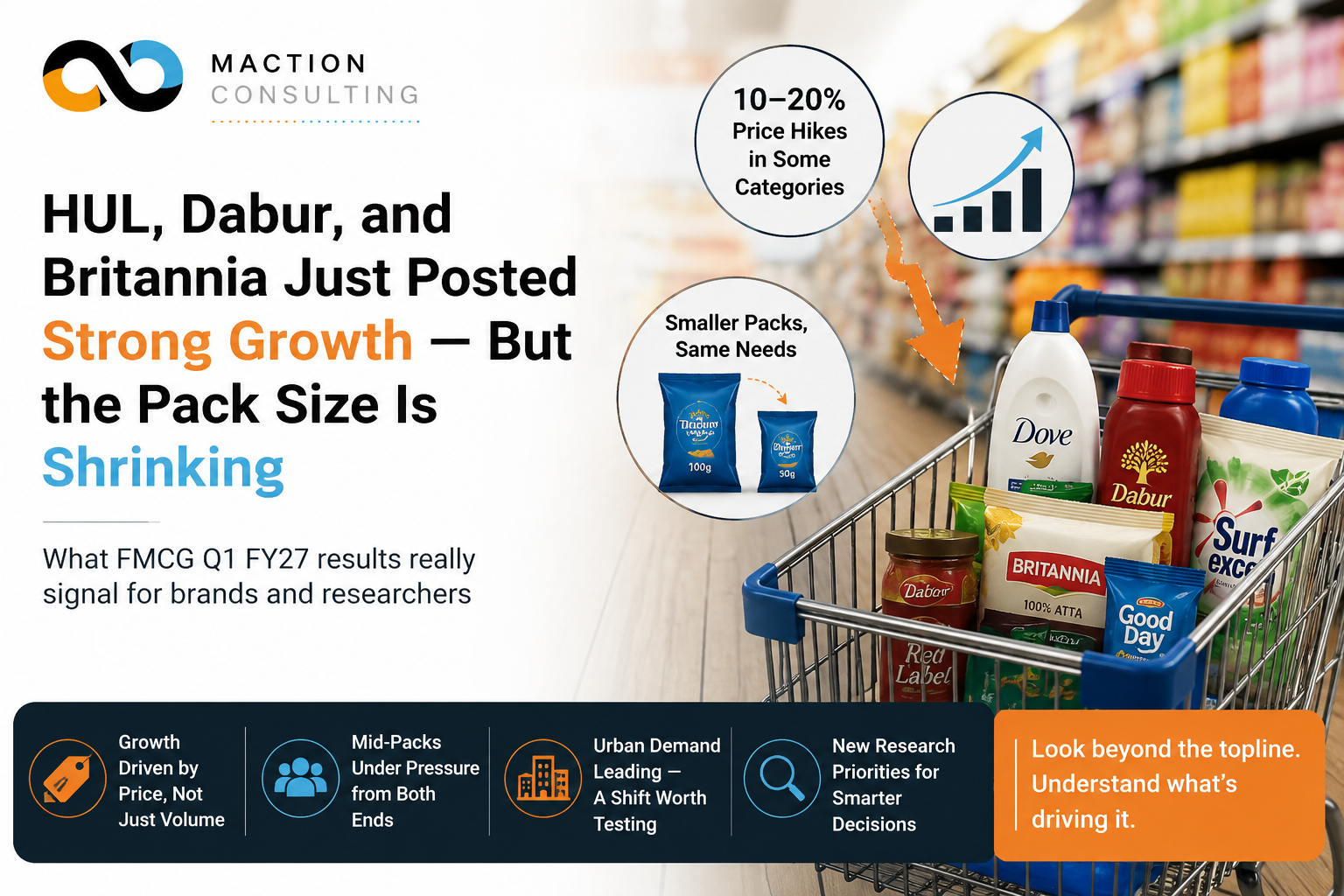

India’s FMCG majors opened FY27 with numbers that, on the surface, look like a genuine turnaround. Hindustan Unilever posted 10% year-on-year revenue growth to ₹17,341 crore in the June quarter — its strongest showing in 13 quarters. Dabur grew revenue 11% with net profit up 15%. Britannia posted a 25.2% revenue jump, with profit after tax climbing nearly 48%. After several quarters of a muted consumption narrative, this reads like relief. But sitting underneath the topline numbers is a detail that matters more for anyone doing category research right now: distributors are reporting price hikes of 10-20% in some categories, and consumers on both ends of the income spectrum are responding the same way — by buying smaller packs.
Revenue Growth and Volume Growth Are Not the Same Story
The quarter’s headline growth is being driven substantially by price, not just volume. Companies have leaned on price hikes and reduced grammage to offset rising input costs — particularly crude-oil-linked packaging and logistics costs, which have moved with the same West Asia-driven volatility that’s been showing up across this year’s inflation data. That combination (raise the price, shrink the pack) is a well-worn FMCG playbook during input-cost pressure, but it means a 10% or 25% revenue jump doesn’t automatically translate into 10% or 25% more product moving off shelves. For category trackers and demand forecasts, treating this quarter’s revenue growth as a proxy for volume recovery would be a meaningful misread.
The Pack-Size Squeeze Is Happening at Both Ends of the Market at Once
What makes this quarter’s data genuinely interesting for research purposes is where the pressure is landing. Rural consumers are shifting toward smaller pack sizes to manage tighter budgets — a familiar, well-documented trade-down pattern. But premium products are simultaneously finding strong traction in cities, with urban demand described as the main growth driver this quarter, outpacing rural for the first time in several quarters. The result, as flagged by the All India Consumer Products Distributor Federation, is that mid-sized packs are the ones actually under pressure — squeezed from below by economy-pack trading down and from above by premium-pack growth. A category that looks stable in aggregate volume terms may be quietly bifurcating into two very different consumer bases with two very different needs.
Urban Demand Leading Again Is a Real Shift Worth Testing
For much of the past two years, the dominant FMCG narrative has been rural demand outpacing urban, driven by government transfers, easing food inflation, and a recovering agricultural cycle. This quarter’s results describe something closer to the reverse: robust urban consumption alongside merely “steady” or “consistent” rural performance, with modern trade, e-commerce, and quick commerce — all disproportionately urban channels — outpacing traditional retail. If this is a genuine reversal rather than a one-quarter blip, it has real implications for distribution investment, channel mix, and where a brand’s next incremental rupee of marketing spend should go — and it’s exactly the kind of shift that deserves a dedicated read rather than being absorbed quietly into a blended national trend line.
What This Means for Research Priorities This Quarter
- Separate price-driven and volume-driven growth explicitly. A category tracker that reports only value growth risks overstating actual demand recovery — pair value metrics with unit/volume data and, where possible, pack-size mix shifts.
- Test mid-pack vulnerability directly. If mid-sized SKUs are genuinely being squeezed from both directions, that’s a distinct research question from “is demand growing” — it’s about where within your portfolio the growth and the erosion are actually happening.
- Revisit the rural-outpacing-urban assumption. Several quarters of category planning may have been built on a rural-led growth thesis that this quarter’s data is starting to complicate — worth testing against your own category’s actual channel mix rather than assuming it still holds.
- Track price-hike absorption by segment. With distributor-reported price increases of 10-20% in some categories, understanding which income segments are absorbing that increase without changing behaviour, and which are trading down or switching brands, is now a live, testable question rather than a theoretical one.
Frequently Asked Questions
Q: Why did HUL, Dabur, and Britannia post strong revenue growth in Q1 FY27 despite inflation?
Q1 FY27 growth at India’s major FMCG companies was driven substantially by price increases and reduced grammage rather than volume recovery alone. Companies raised prices and shrunk pack sizes to offset rising input costs — particularly crude-oil-linked packaging and logistics costs. A 10–25% revenue jump does not automatically translate into equivalent volume growth off shelves.
Q: What is the mid-pack squeeze in FMCG?
The mid-pack squeeze refers to pressure on medium-sized SKUs from two simultaneous directions. Rural consumers are trading down to smaller economy packs to manage tighter budgets. Urban consumers are simultaneously driving premium product growth. Mid-sized packs — which served neither the economy nor the premium end clearly — are losing share from both directions at once.
Q: Is rural or urban FMCG demand stronger in India right now?
Q1 FY27 results describe a reversal of the rural-outpacing-urban trend that dominated the past two years. Urban demand is described as the main growth driver this quarter — outpacing rural for the first time in several quarters — with modern trade, e-commerce, and quick commerce all disproportionately driving growth. Whether this is a genuine sustained reversal or a one-quarter blip is worth testing against your own category’s channel data.
Q: How should FMCG brands read Q1 FY27 results for category planning?
Four research priorities: separate price-driven from volume-driven growth explicitly rather than using revenue as a proxy for demand recovery; test mid-pack vulnerability directly within your own portfolio; revisit the rural-outpacing-urban assumption that may have shaped recent distribution and marketing investment; and track price-hike absorption by income segment to understand which consumers are changing behaviour and which are absorbing the increase.
The Bigger Point
A strong quarter of headline FMCG revenue growth is genuinely good news, and it’s the first sign in over a year that the sector’s growth narrative might be turning a corner. But the mechanics behind that growth — price hikes, shrinking pack sizes, and a possible rural-to-urban demand shift — are exactly the kind of detail that gets lost when a brand reads its own performance only against the sector’s topline number. The companies posting these results clearly know the difference between price-led and volume-led growth internally; the research question for everyone else is whether their own category strategy is being built on the same distinction, or on the headline alone.
If you want a clearer read on where your category’s growth is coming from — price, volume, or pack-size mix — talk to our research team at Maction.