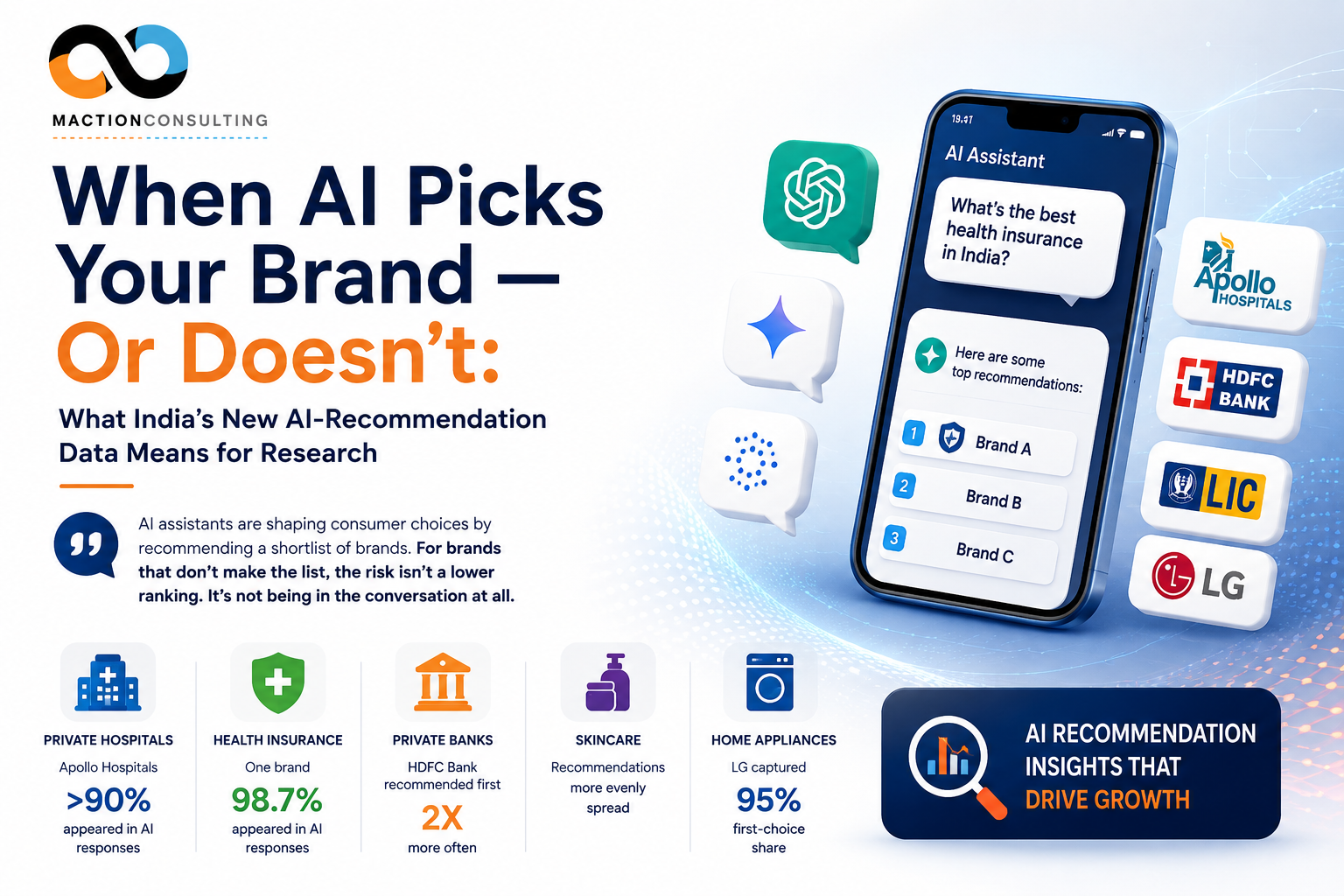

A recent analysis tested how ChatGPT, Gemini, and Perplexity recommend brands across five Indian consumer categories — private hospitals, health insurance, private banks, skincare, and home appliances — running 375 AI responses through standardised prompts. The results were striking: in health insurance, one brand appeared in 98.7% of all responses and was the first recommendation nearly all the time. In home appliances, one brand captured a 95% first-choice share. Consumers increasingly aren’t scrolling through search results anymore — they’re asking an AI assistant what to buy and getting a shortlist of three or four names. For brands that don’t make that shortlist, the risk isn’t a lower search ranking. It’s simply not existing in the conversation at all.
The Numbers That Should Worry Every Challenger Brand
The category-by-category breakdown is worth sitting with. Apollo Hospitals appeared in over 90% of hospital-related AI responses and was the first recommendation more than three-quarters of the time. HDFC Bank and ICICI Bank both appeared in literally every banking response tested, but HDFC was recommended first more than twice as often. LG dominated home appliances almost as completely as the insurance leader dominated its category. Skincare was the one meaningful exception — recommendations were spread more evenly across Minimalist, Cetaphil, and CeraVe, suggesting AI treats some categories as genuinely competitive and others as effectively decided.
The pattern across four of five categories points to something research and marketing teams need to internalise quickly: AI assistants tend to reinforce existing category leaders rather than distributing attention evenly, and the gap between being recommended at all and being recommended first can be enormous even between direct competitors.
Why This Isn’t Just an SEO Problem With a New Name
The instinct is to treat this as SEO 2.0 — optimise your website, add more keywords, and the AI will find you. The evidence suggests that’s the wrong model entirely. Separate research analysing over 25 million AI citations found that the overwhelming majority came from earned media coverage, while paid and advertorial content accounted for a negligible share. AI assistants don’t primarily read a brand’s own website to decide what to recommend — they synthesise signals from independent journalism, expert commentary, comparison articles, review platforms, and forums, then look for corroboration across multiple unrelated sources before recommending a company.
That has a direct implication for how research and content strategy need to work together. A brand can’t simply publish a well-optimised page claiming to be “the best” in its category and expect that to move the needle — what moves an AI’s confidence is whether multiple independent, credible sources happen to agree on the same claim. That’s a fundamentally different game than traditional SEO, and it’s one that starts with research, not copywriting.
We’ve written about how AI in market research is already changing research design more broadly — this is the same shift playing out on the brand visibility side.
Where This Connects Directly to Market Research
This shift creates genuinely new research questions that most brands aren’t currently equipped to answer, and a few are worth building into research programs now rather than after a competitor gets there first:
- AI recommendation share, tracked like a brand health metric. Running standardised prompts across ChatGPT, Gemini, Perplexity, and other assistants on a recurring cadence — the same discipline as a share-of-voice or brand tracker — is now a legitimate and measurable KPI, not a novelty.
- Source-mapping: what’s actually driving your category’s AI recommendations. Since AI models weight independent corroboration heavily, understanding which specific publications, review sites, and forums are being cited across your category is now a research question with real strategic value, not just a PR curiosity.
- The long-tail opportunity for challenger brands. AI naturally favours incumbents with larger digital footprints, but researchers analysing this pattern note that smaller, more specific brands can outperform on narrow, highly specific queries where they demonstrate clearer relevance and expertise. Identifying which long-tail category questions a challenger brand can credibly own is a research exercise, not a guess.
- Consumer trust calibration. Separately, recent India-focused research on AI search adoption found that while a large majority of Indian consumers already use AI assistants for search, most still don’t fully trust AI-generated answers the way they trust traditional search results — meaning AI recommendation share and actual purchase influence aren’t yet the same thing, and measuring that gap matters.
The Honest Caveat: Nobody Can Promise You the Top Spot
It’s worth being direct about the limits here, because the emerging Generative Engine Optimisation (GEO) industry is already prone to overpromising. Independent researchers studying this space are explicit that companies can only influence AI recommendations indirectly and probabilistically — there’s no mechanism equivalent to bidding on a keyword or optimising a meta tag that guarantees placement. International research comparing ChatGPT, Claude, and Gemini recommendations across 50 brands found the three models agreed on the top recommendation for a given query only about 42% of the time, underlining that these outputs are genuinely variable rather than fixed rankings waiting to be gamed.
What This Means for Research Planning in the Second Half of 2026
- Baseline your category now. If you don’t know where your brand currently stands across major AI assistants for your category’s core queries, that’s the first gap to close — before a competitor commissions the same analysis and acts on it first.
- Treat AI visibility as a joint PR, content, and research problem, not a marketing-team-only initiative. Since earned media and independent corroboration drive AI recommendations more than owned content, research needs to identify what those third-party sources are actually saying about your category today.
- Prioritise the long tail over the flagship query. “Best bank in India” is likely already decided; the more researchable opportunity is mapping the dozens of specific, lower-competition questions where a smaller brand can credibly become the AI’s answer.
Frequently Asked Questions
Q: What is Generative Engine Optimisation (GEO)?
Generative Engine Optimisation (GEO) is the emerging practice of improving a brand’s visibility in AI-generated responses from tools like ChatGPT, Gemini, and Perplexity. Unlike traditional SEO, which targets search engine rankings, GEO focuses on building the independent, corroborated digital footprint that AI assistants synthesise when deciding which brands to recommend.
Q: How do AI assistants decide which brands to recommend in India?
Research analysing over 25 million AI citations found that AI assistants primarily draw on earned media — independent journalism, expert commentary, review platforms, and forums — rather than a brand’s own website. Recommendations are driven by corroboration across multiple unrelated credible sources, not by paid content or well-optimised brand pages.
Q: Can brands guarantee they appear in AI recommendations?
No. Independent researchers are explicit that AI recommendation placement can only be influenced indirectly and probabilistically. There is no equivalent to bidding on a keyword. Research comparing ChatGPT, Claude, and Gemini found the three models agreed on the top recommendation for a given query only about 42% of the time — these outputs are genuinely variable, not fixed rankings.
Q: What should challenger brands do about AI recommendations?
Focus on the long tail. AI naturally favours incumbents with larger digital footprints on broad category queries. Smaller brands can outperform on narrow, specific queries where they demonstrate clearer relevance and expertise. Identifying which long-tail questions a challenger brand can credibly own is a research exercise — mapping competitor AI share, source gaps, and corroboration opportunities — not a guess.
The Bigger Point
This is one of the rare moments where a genuinely new category of consumer behaviour — asking an AI what to buy instead of comparing options yourself — is measurable early enough that brands still have time to build a research-backed response rather than react after the fact. The category leaders in this recent analysis didn’t get there by accident; they got there because independent sources already corroborated their leadership before AI assistants started summarising it. That’s a research and reputation problem before it’s a marketing one.
If you want to understand where your brand currently stands in AI-generated recommendations for your category — and what’s driving that position — talk to our research team at Maction.