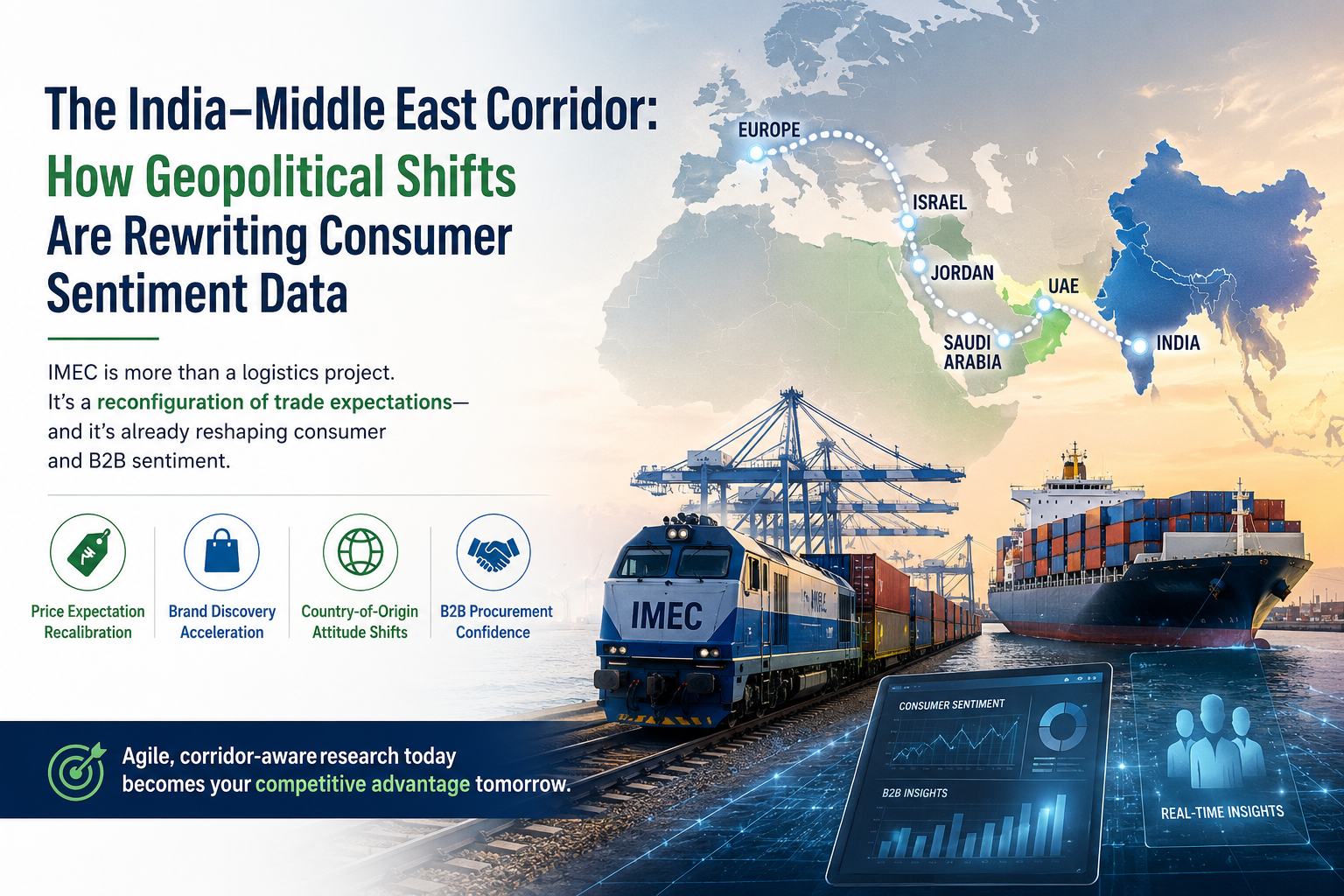

The India–Middle East–Europe Economic Corridor (IMEC), formalised at the G20 in September 2023 and gaining commercial traction through 2025–26, is more than a logistics project. It is a reconfiguration of trade expectations — and with it, a measurable shift in consumer and business sentiment across two of the world’s most dynamic growth markets.
For organisations that rely on market research to guide strategy, this is a direct challenge. India Middle East Corridor consumer sentiment is changing faster than most annual tracking studies can capture. If your consumer data predates 2024, it may no longer accurately reflect the market you think you understand.
What IMEC Is Changing for Consumer and B2B Markets
IMEC proposes a ship-to-rail network connecting Indian ports to the UAE, Saudi Arabia, Jordan, and Israel, and onward to Europe. The practical outcomes — faster transit, lower tariffs, reduced supply chain friction — create second-order effects that directly touch buyer attitudes and commercial expectations.
The key sentiment shifts underway include:
- Price expectation recalibration: Consumers and procurement teams in GCC markets are adjusting their willingness to pay for Indian-origin goods, particularly across FMCG, pharmaceuticals, textiles, and engineering components.
- Brand discovery acceleration: Indian brands previously limited to diaspora channels are entering mainstream GCC retail. Consumer familiarity and trust data for these categories are in active flux.
- Country-of-origin attitude shifts: Consumer surveys from 2024–25 show an uptick in positive associations with ‘Made in India’ products among younger, digitally active GCC buyers.
- B2B procurement confidence: Indian exporters and Middle Eastern importers are both reporting higher confidence in long-term sourcing relationships — a signal that pre-IMEC procurement intent data needs refreshing.
Why Traditional Market Research Struggles During Geopolitical Change
The core challenge is temporal mismatch. Geopolitical developments like IMEC unfold at diplomatic speed. Consumer sentiment, however, can shift even faster — often preceding actual trade activity, as anticipation drives attitude change ahead of any real-world delivery.
Traditional annual tracking studies cannot keep pace. The structural problems are straightforward:
- Annual surveys report on sentiment from six to twelve months ago by the time data is published.
- Syndicated category reports average across large geographies, masking corridor-specific shifts happening in port cities, trade zones, and digitally connected urban centres.
- Cross-border research design requires specialist capability — regulatory knowledge, language variation, cultural context — that many in-house teams lack.
The result is a growing gap between the data companies rely on and the market reality they are navigating. Organisations that invest in agile, corridor-aware research will hold a measurable information advantage.
What India Middle East Corridor Consumer Sentiment Research Should Actually Measure
For businesses commissioning or refreshing research in this context, the brief needs to evolve. Robust corridor-era studies should capture:
- Category-level price expectation mapping: The gap between current price perception and post-corridor expectation is critical for Indian exporters setting 2026–28 pricing strategy.
- Country-of-origin attitude tracking: Brand equity is inseparable from origin associations. Regular tracking of attitudes toward Indian-origin products across UAE, Saudi Arabia, and the broader GCC should now be a baseline requirement.
- B2B procurement intent: Decision-makers in Middle Eastern procurement are actively reassessing supplier strategies. Capturing their current intent, concerns, and evaluation criteria is essential intelligence for Indian companies targeting institutional buyers.
- Employee and talent sentiment: IMEC is reshaping labour market expectations on both sides. Indian professionals assessing GCC opportunities and GCC employers evaluating Indian talent pipelines are both operating with changing sentiment profiles.
Example: Shifting Retailer Sentiment in UAE Food & Beverage
Prior to 2023, consumer research in UAE food and beverage consistently showed Indian brands performing strongly within the South Asian diaspora, with limited mainstream traction. Following IMEC announcements and broader normalisation of India–UAE trade relations, several Indian F&B brands reported noticeably improved buyer receptiveness during retail negotiations.
The brands best placed to capitalise were those that had commissioned fresh consumer research in 2024, specifically tracking shifts in mainstream awareness and purchase consideration. Their data gave them the evidence base to justify premium shelf placement and reframe their positioning from ‘diaspora staple’ to ‘quality Indian brand for all’. Legacy data from 2021–22 would have told a very different, and strategically misleading, story.
Actionable Insights for Businesses Operating Across the Corridor
- Audit your consumer data for temporal relevance. Any research completed before Q1 2024 should be reviewed and gap-filled for the most business-critical data points.
- Design for corridor geography, not national averages. Sub-regional and city-level sampling will capture the sentiment shifts that GCC-wide averages conceal.
- Integrate geopolitical context into your research brief. Stimulus materials and question framing need to reflect the commercial backdrop, or you will get flatter, less actionable data.
- Invest in qualitative depth alongside quantitative tracking. In a period of rapid change, understanding the ‘why’ behind attitude shifts is as important as measuring the ‘what’.
- Move to semi-annual or quarterly pulse surveys in high-exposure sectors, including FMCG, pharma, logistics, retail, and financial services.
Frequently Asked Questions
What is IMEC and why does it matter for consumer research?
IMEC is a multimodal trade route connecting India to European markets via the Gulf, designed to reduce transit times and costs. For consumer researchers, it matters because it is actively reshaping price expectations, brand perceptions, and purchasing behaviour. Consumer attitudes formed in a pre-IMEC trade environment are unreliable guides to behaviour in a post-IMEC one.
How quickly does geopolitical change affect consumer sentiment?
Faster than most organisations expect. Research from analogous trade events — including the UAE–Israel Abraham Accords in 2020 — shows measurable shifts in commercial sentiment within six to twelve months of a major policy announcement, well before physical infrastructure is operational. Tracking needs to begin now, not once IMEC’s routes are fully active.
Which industries are most exposed to IMEC-driven sentiment shifts?
The highest-exposure categories are FMCG, pharmaceuticals, textiles, engineering components, financial services, logistics, and digital technology products. Both B2C and B2B buyer sentiment are in flux across these sectors. Organisations operating in any of them should treat consumer and procurement research as a current business priority.
Can we rely on existing syndicated data to track these changes?
Syndicated data has value, but it is structurally limited here. Most studies are designed around national averages, and published data is typically six to eighteen months behind market reality. For corridor-specific questions — cross-border attitude shifts, procurement behaviour, brand perception in trade-active geographies — custom primary research is necessary.
How Maction Can Help
Maction Consulting brings deep expertise in consumer research, B2B market research, employee insight, and data analytics across India and international markets. Our capabilities directly relevant to corridor-era research include cross-border consumer sentiment studies for Indian and GCC markets, B2B procurement intent research and buyer journey mapping, employee sentiment research, brand perception tracking with custom fieldwork design, and agile survey deployment for time-sensitive briefs.
If your organisation is operating in or expanding into India–Middle East trade markets and needs a research partner with the regional expertise to deliver actionable intelligence, contact Maction Consulting to discuss a tailored research design.
The Takeaway
India Middle East Corridor consumer sentiment is already shifting — in the categories buyers prioritise, the brands they are warming to, and the price expectations they carry into retail and procurement decisions. For companies relying on market research to guide strategy, this is a direct call to act. Legacy data produces legacy conclusions. The businesses that invest in fresh, corridor-aware consumer insight now will enter the next phase of India–Middle East trade with a measurable competitive advantage.