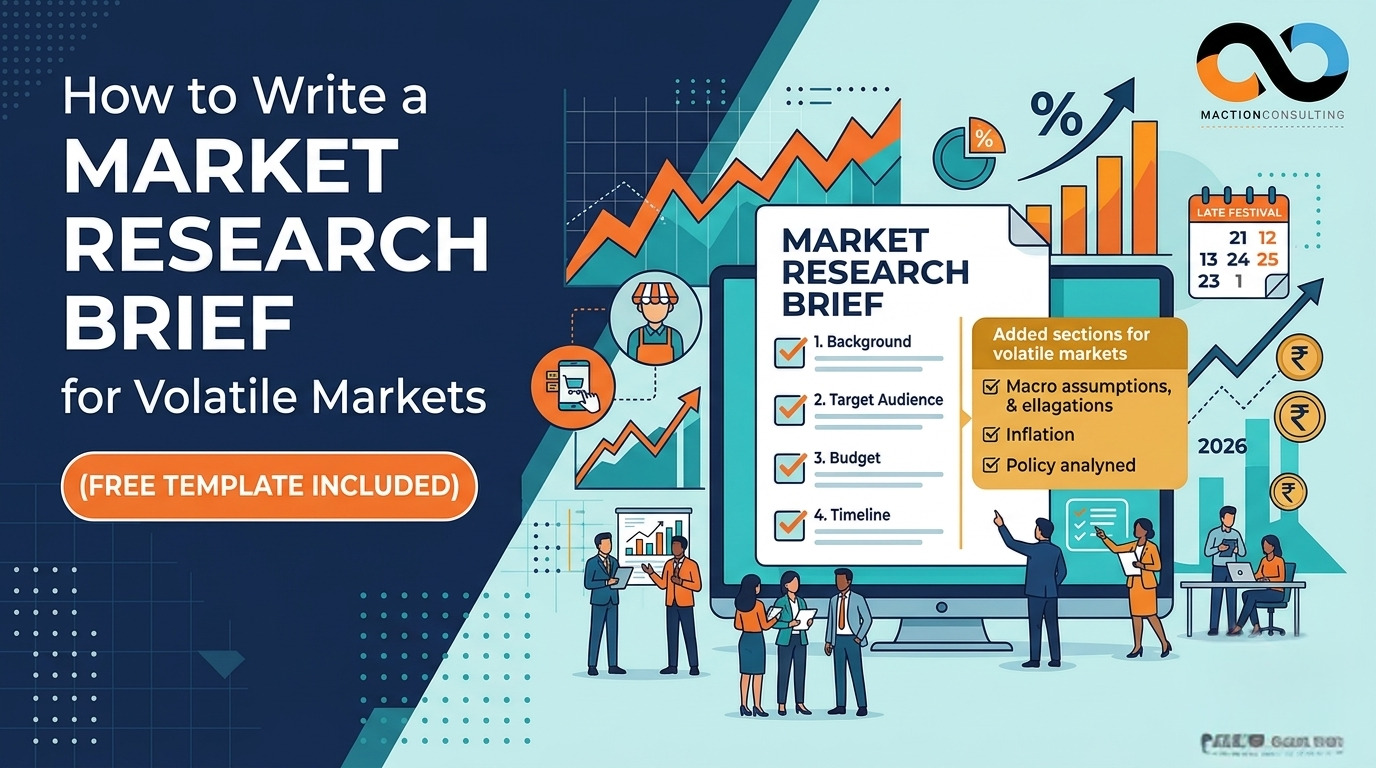

A market research brief is a short document that tells a research agency, or your internal team, what business decision the research needs to support, who needs to be researched, and what you expect to receive at the end. In 2026 that is harder than it sounds, because the market the research is meant to describe keeps moving. Retail inflation reached 6.09% in October, above the RBI’s 6% upper tolerance limit, with food inflation at 8.94%. The RBI raised the repo rate on October 7, and ICRA expects another hike in December. The UPI merchant fee has been deferred but still had no start date in mid-November. And this year’s festive calendar sat about two and a half weeks later than last year’s.
A brief written as if none of this were happening produces research that is hard to interpret. This guide covers the standard brief, gives you a free template, and adds four sections for periods when conditions are changing.
What Is a Market Research Brief?
The brief is the buyer’s document. It describes the problem and the constraints, and it leaves the choice of method open unless you have a strong reason to specify one. It’s often confused with two related documents, and the distinction is worth getting right:
| Document |
Who writes it |
What it does |
| Research brief | The client or research buyer |
States the business problem, objectives, audience, and constraints |
|
RFP |
The client, usually through procurement |
A formal, structured request that agencies must answer in a set format |
|
Proposal |
The agency |
Responds to the brief with a recommended design, timeline, and cost |
What Is Moving Right Now, and What to Add to Your Brief
Five things currently affect how research results should be designed and read. The table shows where each stands and what it means for the brief. We update it as new data is released.
| What is moving | Latest reading (as of November 16, 2026) |
What to add to your brief |
|
Inflation |
CPI inflation was 6.09% in October, above the RBI’s 6% upper tolerance limit. Food inflation was 8.94%, with rural CPI at 6.63% and urban at 5.41%. Onion prices were up 116% year on year. The next CPI release is on December 14. |
Define how price perception should be measured, split rural and urban results, and name the staples that matter to your category. |
|
Interest rates |
The RBI raised the repo rate by 25 basis points to 5.50% on October 7. ICRA expects another hike in December. |
For big-ticket or financed categories, ask the agency to test how rate expectations affect purchase timing. |
|
Payments policy |
NPCI deferred the UPI merchant fee to “immediately post Diwali.” As of November 16, no start date had been notified. NPCI has since issued a small-merchant support scheme, in a circular dated November 11, that runs for three years from the MDR start, and a legal challenge is reported to be pending in the Supreme Court. |
State the baseline you want captured before the date is announced, and whether merchants should be in the sample. |
|
Calendar |
Diwali fell on November 8 this year against October 20 last year. The online festive sales opened on October 8-9, roughly two and a half weeks later than in 2025. |
Fix the comparison window and ask for results by position in the festive run-up, not just by calendar date. |
|
Data timing |
Monthly GST collections mostly reflect the previous month’s transactions, so October’s figures describe September activity. |
Build checkpoints around the dates when each data source will show your period. |
Be especially careful with year-on-year comparisons. Last October’s inflation reading was a record low of 0.25% as reported at the time, and in September 2025 many buyers delayed purchases ahead of the GST rate cuts. A growth rate measured against an unusual base can overstate or understate underlying momentum. Say in the brief which comparison period you want, and ask for two-year comparisons where it matters.
The Standard Template: 13 Sections
Thirteen sections cover most briefs. You don’t need a page for each, and many can be two or three sentences. Copy the table below into a document and fill it in.
| Section |
What to write |
|
1. Background |
Two to four sentences on your company, product, and market. What has changed that makes this research necessary now? |
|
2. The decision |
The specific decision this research will inform, who makes it, and by when. Example: whether to launch in Tier II cities in Q2. |
|
3. Objectives |
Three to five objectives, each starting with a verb. Example: measure awareness of our brand among category buyers in six cities. |
|
4. Research questions |
The questions you most need answered. Add any hypotheses you want tested. |
|
5. Target audience |
Who exactly should be interviewed? Define qualifying criteria such as age, city tier, purchase behaviour, and category usage. |
|
6. Geography and scope |
Cities, states, or countries, and any markets that are explicitly out of scope. |
|
7. Methodoloy preferences |
Methodology you prefer or rule out, and where you are open to the agency’s advice. |
|
8. Sample and sub-groups |
Target sample size and the segments you need to analyse separately, such as gender, income class, age band, SEC etc. |
|
9. Timeline |
Milestones with indicative Start date and end date |
|
10. Budget |
A range or ceiling, if you can share one. It lets agencies propose a budget that fits. |
|
11. Deliverables |
Report, dashboard, raw data, tabulations, or presentation, and who the audience is. |
|
12. Stakeholders |
Who approves the questionnaire, who receives the findings, and who is the single point of contact. |
| 13. Constraints |
Confidentiality, brand restrictions, data privacy and consent requirements, and anything the agency must not do. |
Four Sections to Add When Conditions Are Changing
When inflation, rates, or policy are in motion, add these to the standard template. They cost a few sentences each and prevent the most common problems with interpreting results.
|
Added section |
What to write |
|
14. Macro assumptions |
The conditions you are assuming, such as inflation, interest rates, and pending policy changes, and which of them would change your question if they moved. |
|
15. Comparison base and calendar |
The period results will be compared against, any known distortions in that period, and whether you want two-year comparisons. Note shifts in festive or seasonal dates. |
|
16. Field window and cadence |
How long fieldwork can run, and whether a single wave or repeated short waves would suit the question. Avoid straddling a major announcement if you can. |
|
17. Re-scoping triggers |
The events that would prompt a change to the study, such as a policy notification or rate decision, and who has authority to approve the change. |
An Illustrative Example
The example below is hypothetical and is meant only to show the level of detail that works. This is not a real client brief.
- Background: A packaged-snack brand sells through general trade and e-commerce in metro cities and is considering a millet-based range.
- Decision: Whether to launch the range in the next two quarters and, if so, in which price band.
- Objectives: Measure interest in millet-based snacks among regular snack buyers, identify the price range buyers consider acceptable, and understand which usage occasions matter most.
- Audience: Adults aged 22 to 45 who bought packaged snacks at least twice in the last month, in six cities across three city tiers, with rural and urban results reported separately.
- Sample: A target of 600 completes, with results readable separately by city tier.
- Macro assumptions: Food prices are assumed to stay elevated through fieldwork. The agency should flag how sensitive price-acceptance results are to that assumption.
- Comparison base: Compare against the same period two years ago as well as last year, since last year’s festive season ran on a different calendar.
- Field window: Three weeks, completed before any major policy announcement we have flagged, with an optional second short wave.
- Deliverables: A presentation, a tabulated data file, and a one-page summary for the leadership team.
A brief like this leaves room for the agency to recommend methods, such as a pricing study alongside a concept test, while giving it enough to propose a realistic design.
Common Mistakes to Avoid
- Starting with the method instead of the problem. “We want a survey of 1,000 people” tells an agency less than “we need to decide whether to launch in Tier II cities.”
- Treating last year as a clean baseline. Calendar shifts, policy changes, and unusual prices last year can distort comparisons. State the base you want and the reasons.
- Ignoring the macro backdrop. A price-acceptance study run during a spike in food prices can give different answers from one run a quarter later. Say what conditions you are assuming.
- Listing too many objectives. More than five usually means the study is trying to answer several different questions and will answer none of them well.
- Leaving out the budget. Without a range, agencies have to guess, and proposals end up too far apart to compare.
- Forgetting sample requirements for sub-groups. If you need to compare segments, say so in the brief, because it changes the sample size. Our guide to survey sample size explains why.
Frequently Asked Questions
What is a market research brief?
It is a document written by the research buyer that states the business problem, objectives, audience, timeline, budget, and deliverables, so that a research agency can propose a suitable study.
How long should a research brief be?
Most are one to three pages. Length matters less than clarity on the decision, the audience, and the constraints.
How does inflation affect a market research brief?
It affects how price perception, price acceptance, and spending intent should be measured and interpreted. A good brief states the conditions being assumed, asks for rural and urban results where they differ, and specifies the comparison period.
Should I revise my brief when interest rates change?
If your category relies on financing, such as vehicles, durables, or housing, it is worth asking how rate expectations affect purchase timing. A re-scoping trigger in the brief makes it clear when and how to adjust the study.
What is the difference between a research brief and an RFP?
A brief describes the problem and constraints in whatever format suits the buyer. An RFP is a formal request, often run through procurement, that requires agencies to respond in a set structure.
Does a brief need to cover data privacy?
If the study collects personal data, state your consent, retention, and data-sharing requirements up front. India’s data protection rules are being phased in, and it is easier to build these into the design than to retrofit them.
Getting Started
A good brief doesn’t need to be long. It needs to state the decision, define the audience, and be honest about the constraints, including the ones outside your control. If you have a draft and want a second opinion before you send it to agencies, we’re happy to look at it.
If you’re planning a study and want help shaping the brief or choosing a method, talk to our research team at Maction or e-mail us at info@maction.com